 Cart is empty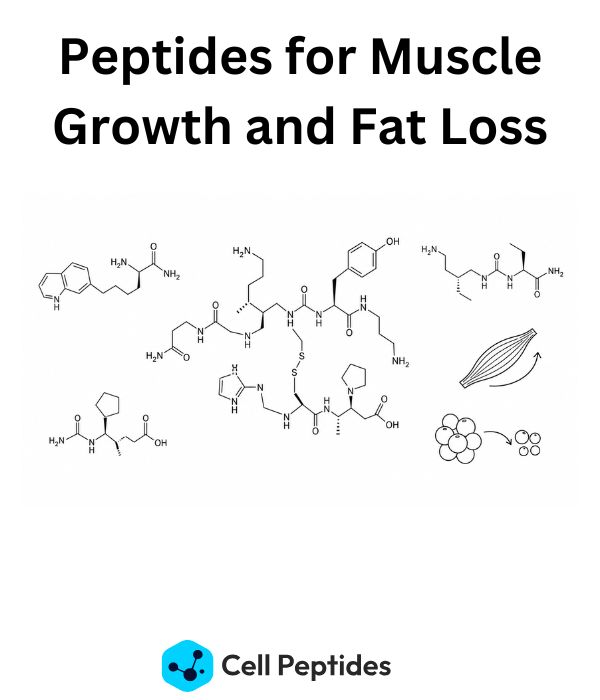
Peptides for muscle growth and fat loss are being studied as potential tools for body recomposition, in which lean mass is increased or preserved while body fat is reduced.
Research in this area generally falls into two distinct categories:
- Growth hormone (GH)-releasing hormones (GHRH) that influence GH and insulin-like growth factor 1 (IGF-1) signaling
- Glucagon-like peptide 1 (GLP-1) and multi-receptor agonists that primarily reduce appetite, energy intake, and body weight
These compounds (also known as secretagogues) may affect the same outcome, but they work through different biological mechanisms. A secretagogue that increases release of growth hormone should not automatically be assumed to produce muscle gain. Similarly, a compound that leads to substantial weight loss should not automatically be described as muscle-preserving.
This article provides an overview of the research approach and the available evidence behind peptides for weight loss and muscle growth, including where the data are strong, limited, or still preliminary.
What Is Body Recomposition in Peptide Research?
Body recomposition refers to changing the proportion of fat mass and lean mass without relying exclusively on total body weight.
A person or research participant may lose 10 kilograms, but that number alone does not show whether the loss consisted of:
- Adipose (fat) tissue
- Skeletal muscle
- Glycogen and associated water
- Organ tissue
- Extracellular fluid
- A combination of these
This distinction matters because muscle gain and fat loss require different energy conditions, making the research problem complex.
The formation of new muscle tissue is generally supported by sufficient dietary protein, mechanical loading (training), and adequate energy availability. Fat loss usually requires sustained energy expenditure above energy intake.
Body recomposition attempts to produce both outcomes within the same time period or at least reduce fat while maintaining most functional muscle tissue.
Growth hormone is relevant because it affects protein, glucose, and lipid metabolism. It can increase the use of stored fatty acids while influencing amino acid uptake and protein turnover.[1] These biological effects have led to an interest in growth hormone-releasing peptides as possible research tools to promote muscle growth while also encouraging the breakdown of stored fat.
GLP-1-based compounds like semaglutide, tirzepatide, and retatrutide primarily reduce appetite and calorie intake. In this model, muscle preservation is not necessarily a direct effect of the compound, which explains why they are often studied in combination with GH-releasing peptides
How Can Peptides Influence Muscle Growth and Fat Loss Simultaneously?
GHRH and IGF-1 Signaling
GHRH secretagogues stimulate the release of endogenous growth hormone from the pituitary gland.
Some peptides trigger this release by stimulating the body’s natural GH-releasing receptor, while others activate the ghrelin receptor, which affects hunger and satiety.
Growth hormone can stimulate the liver to produce IGF-1, leading to protein turnover, while also stimulating lipolysis (fat burning) in adipose tissue.
Additionally, both GH and IGF-1 participate in processes associated with:
- Amino-acid transport
- Nitrogen retention
- Connective-tissue synthesis
- Glucose metabolism
This dual mechanism explains why GHRH secretagogues are often considered important peptides for fat loss and muscle growth.
However, hormone secretion in itself does not guarantee a body composition result. A laboratory study may show that a compound increases GH or IGF-1 levels in the body without leading to an increase in functional skeletal muscle.
This distinction is important when interpreting short-term studies. Changes in IGF-1 levels can be detected within days, while measurable changes in muscle architecture, strength, and fat distribution require longer observation.
A systematic review of growth hormone administration in healthy, physically fit adults found changes in body composition but did not establish a consistent improvement in strength or exercise performance.[2] Useful research on hormone-releasing compounds will therefore distinguish between hormone levels from functional outcomes.
GLP-1, GIP, and Glucagon Signaling
GLP-1 receptor agonists such as semaglutide primarily affect appetite, food intake, glucose-dependent insulin secretion, and gastric emptying.
However, these compounds can vary in how many receptors they target:
- Tirzepatide activates GLP-1 and glucose-dependent insulinotropic polypeptide (GIP) receptors
- Retatrutide activates GLP-1, GIP, and glucagon receptors
These secretogues are not direct muscle-building peptides.
Their relevance to body recomposition comes from their ability to produce substantial fat and body weight reduction. The central research question is whether that reduction occurs while an acceptable proportion of lean mass, physical strength, and functional capacity is retained.
Lean-mass preservation can be influenced by:
- Protein intake
- Resistance exercise
- Starting body-fat percentage
- Age
- Rate of weight loss
- Sex
- Insulin sensitivity
- Baseline muscle mass
- Duration of the calorie deficit
A decrease in measured lean mass as measured by dual-energy X-ray absorptiometry (DXA) also does not always equal an identical loss of contractile skeletal muscle. DXA-derived lean mass includes body water, organs, connective tissue, and glycogen-associated fluid.
Growth Hormone Secretagogues Studied for Body Recomposition
CJC-1295 and Prolonged GHRH Signaling
CJC-1295 with DAC is a modified GHRH analog designed to remain active longer than the body’s natural GHRH.
In two randomized, placebo-controlled, dose-escalation trials, CJC-1295 increased mean GH concentrations for several days and raised IGF-1 for approximately one to two weeks after administration.[3]
A separate analysis found that CJC-1295 increased mean and trough GH concentrations while maintaining the body’s natural pulses of GH secretion.[4]
This is an important pharmacological distinction. Continuous external GH exposure and amplified endogenous pulses do not produce identical concentration patterns.
However, the main CJC-1295 studies focused on pharmacokinetics, hormone concentrations, and short-term safety. They did not establish whether CJC-1295 reliably increased muscle mass or reduced fat in healthy, resistance-trained participants.
The results therefore support the statement that CJC-1295 activates the GH/IGF-1 axis. Claims of visible body recomposition will require further targeted research.
Ipamorelin and Selective GH Release
Ipamorelin is a pentapeptide GH secretagogue that activates the ghrelin receptor (otherwise known as GHS-R1a).
Preclinical pharmacology studies characterized ipamorelin as a relatively selective GHRH, with less direct stimulation of adrenocorticotropic hormone (ACTH) and cortisol than several earlier secretagogues.[5]
A pharmacokinetic and pharmacodynamic study involving healthy male volunteers found a dose-dependent relationship between ipamorelin exposure and growth hormone release.[6]
This evidence confirms pharmacodynamic activity of ipamorelin in humans. It does not demonstrate that ipamorelin directly produces muscle hypertrophy, increased strength, or clinically meaningful fat reduction.
A suitable ipamorelin study would therefore need to measure more than serum GH. Relevant outcomes could include:
- DXA-derived fat and lean mass
- Magnetic resonance imaging (MRI)-measured muscle volume
- Muscle-fiber cross-sectional area
- Strength testing
- Resting energy expenditure
- Visceral adipose tissue
- IGF-1 and glucose regulation
Without these measurements, the result remains simply a hormone response rather than verified body recomposition.
GHRP-6 and Ghrelin-Receptor Activity
GHRP-6 is a synthetic growth hormone-releasing hexapeptide that acts through the ghrelin receptor.
Studies in humans have shown that GHRP-6 can produce a substantial GH response, particularly when it is studied alongside GHRH.[7]
A pharmacokinetic study in healthy male volunteers also documented rapid absorption and a short elimination half-life following administration.[8]
GHRP-6 presents a specific complication for fat-loss research: ghrelin-receptor activation is connected to appetite and meal initiation.
Direct data on human appetite are more extensive for a closely related ghrelin-receptor peptide, GHRP-2, than for GHRP-6 itself. In controlled experiments, GHRP-2 increased food intake and subjective appetite in healthy adults.[9] Given that GHRP-2 and GHRP-6 both act on the ghrelin receptor, appetite should be treated as a possible confounding variable in GHRP-6 research.
A stronger GH response could theoretically increase lipolysis while increased hunger raises calorie intake. The net change in fat mass would depend on which effect dominates under the study conditions.
GLP-1 and Multi-Receptor Peptides Studied for Fat Loss
Semaglutide and Changes in Fat and Lean Mass
Semaglutide is a long-acting GLP-1 receptor agonist.
In the STEP 1 trial, adults with overweight or obesity who received semaglutide alongside lifestyle intervention experienced an average body weight reduction of approximately 14.9% after 68 weeks, compared with 2.4% in the placebo group.[10]
A body-composition subgroup was evaluated using DXA. Semaglutide produced reductions in total fat mass and visceral fat, and absolute lean mass also declined.[11]
The proportion of total body weight represented by lean mass improved because fat mass declined more sharply. That means some lean tissue was lost.
This distinction should be explained clearly:
- Absolute lean mass decreased
- Total fat mass decreased to a greater extent
- The relative percentage of lean mass increased
Semaglutide may therefore improve the overall fat-to-lean ratio while still producing a measurable reduction in absolute lean tissue.
For body-recomposition research, semaglutide studies should combine body-composition imaging with strength, protein intake, and physical function measurements.
Tirzepatide and Dual-Receptor Signalling
Tirzepatide activates both GIP and GLP-1 receptors.
In the 72-week SURMOUNT-1 trial, mean body weight changes were:
- 15.0% in the 5 mg group
- 19.5% in the 10 mg group
- 20.9% in the 15 mg group
- 3.1% with placebo[12]
A later SURMOUNT-1 DXA substudy examined the composition of the weight reduction. Approximately 75% of the weight lost was estimated to be fat mass and around 25% lean mass.[13]
This ratio was broadly consistent with the tissue distribution commonly observed during conventional weight reduction.
The findings do not establish tirzepatide as a muscle-building agent. They indicate that fat constituted the majority of the measured weight reduction.
It is also important for researchers to distinguish muscle quality from total muscle volume. Reductions in intramuscular fat can improve body composition even when overall muscle volume declines alongside substantial body weight loss.
Retatrutide and Triple-Receptor Activity
Retatrutide is an investigational agonist of the GIP, GLP-1, and glucagon receptors.
In a peer-reviewed phase 2 obesity trial, the highest studied dose group experienced a mean body weight reduction of 24.2% at 48 weeks.[14]
In May 2026, Eli Lilly announced topline findings from the phase 3 TRIUMPH-1 trial. Participants in the 12 mg study group lost an average of 28.3% of body weight at 80 weeks, compared with 2.2% for placebo. In a prespecified extension involving participants with a baseline BMI of at least 35, average weight reduction reached 30.3% at 104 weeks.
These phase 3 figures are based on company-reported topline results. A complete peer-reviewed publication has not yet been released, so a detailed independent assessment of the full dataset remains pending.
Retatrutide also remains investigational and has not been approved by the FDA or another major regulatory authority as of June 2026.
The addition of glucagon-receptor activity distinguishes retatrutide from semaglutide and tirzepatide and could affect energy expenditure, liver metabolism, and glucagon use. Whether retatrutide preserves lean tissue more effectively than GLP-1 or GLP-1/GIP agonists has not yet been established.
For further information on this compound class, see the GLP-1 peptide research category.
What Does the Evidence Actually Show?
The quality of evidence differs substantially between the two main peptide categories.
For CJC-1295, ipamorelin and GHRP-6, studies in humans support the following conclusions:
- The compounds can stimulate GH release
- CJC-1295 can raise IGF-1 for an extended period
- Some GH secretagogues preserve or amplify pulsatile GH secretion
- Ghrelin-receptor agonism may influence appetite
Evidence is far less complete for:
- Long-term muscle hypertrophy
- Strength improvement
- Athletic performance
- Visceral-fat reduction
- Simultaneous muscle gain and fat loss in trained adults
For semaglutide and tirzepatide, the weight-loss evidence is considerably stronger. Large randomized trials demonstrate substantial reductions in body weight, with body-composition substudies showing that most of the lost tissue consists of fat.
However, some absolute lean mass is usually lost as well.
Retatrutide has generated larger weight-loss percentages in phase 2 research and phase 3 topline reporting. Its longer-term safety, lean-mass effects, and comparative performance still require complete peer-reviewed phase 3 data.
The most defensible summary is that GH secretagogues and incretin-based compounds influence distinct parts of body recomposition.
There is evidence that GH secretagogues lead to anabolic and lipolytic activity. GLP-1-based compounds provide stronger evidence of substantial fat and weight reduction. Neither category guarantees simultaneous muscle growth and fat loss.
Designing a Body-Recomposition Peptide Test/Study
A useful study will define the primary outcome measure before the compound is introduced.
For GH-axis research, possible primary endpoints include:
- Pulsatile GH secretion
- Serum IGF-1
- Nitrogen balance
- Muscle-protein synthesis
- Lean-tissue volume
- Strength or force output
For GLP-1 research, the primary endpoints might include:
- Total fat mass
- Visceral fat
- Energy intake
- Waist circumference
- Body weight
- Glucose regulation
Lean mass, muscle strength, and physical performance should be included as secondary or co-primary endpoints when investigating substantial weight loss.
Body-Composition Measurements
DXA can estimate:
- Total fat mass
- Regional fat distribution
- Bone mineral content
- Lean soft tissue
MRI and computed tomography (CT) can provide more detailed measurements of:
- Visceral adipose tissue
- Subcutaneous adipose tissue
- Muscle cross-sectional area
- Muscle volume
- Intramuscular fat infiltration
Scale weight and circumference measurements are useful but cannot independently determine which type of tissue changed.
Variables That Should Be Controlled
Researchers should monitor:
- Total energy intake
- Protein intake
- Resistance-training volume
- Aerobic activity
- Sleep duration
- Hydration
- Sodium intake
- Carbohydrate intake
- Glycogen status
- Concurrent medications or research compounds
- Illness and inflammation
A sudden reduction in dietary carbohydrate can lower glycogen and associated water, making lean mass appear to fall before meaningful muscle loss has occurred.
A peptide calculator can assist with concentration arithmetic in laboratory protocols. Solvent selection, including whether bacteriostatic water is appropriate, should be determined using compound-specific stability and assay requirements.
Safety and Regulatory Considerations
Research compounds should not be presented as approved bodybuilding products or substitutes for authorized medicines.
Semaglutide and tirzepatide are active ingredients in regulated prescription products for specific medical indications. Products sold online under research labels are not automatically equivalent to those authorized formulations.
The FDA has warned that illegally marketed semaglutide, tirzepatide, and retatrutide products may contain incorrect concentrations, inappropriate ingredients, or harmful contaminants.
CJC-1295, ipamorelin, and GHRP-6 are not FDA-approved for increasing muscle mass, reducing fat, or improving athletic performance.
Taakeaways
Peptides for muscle growth and fat loss are still being investigated.
Growth hormone secretagogues such as CJC-1295, ipamorelin, and GHRP-6 stimulate hormone pathways associated with protein metabolism and lipolysis. Evidence in humans confirms GH or IGF-1 responses, but direct evidence of meaningful muscle gain and fat reduction remains limited.
GLP-1 and multi-receptor agonists such as semaglutide, tirzepatide, and retatrutide have stronger evidence for reducing body weight and fat mass. Some absolute lean mass is commonly lost with these compounds, making protein intake, resistance exercise, and direct body-composition measurement important research variables.
Explore related materials in the peptides for bodybuilding, fat-burning peptides and GLP-1 peptides categories.
Frequently Asked Questions
Certain peptides affect pathways relevant to both outcomes, but current evidence does not show that every compound can reliably increase muscle while reducing fat.
GH secretagogues can stimulate GH and IGF-1 signaling. GLP-1-based compounds can produce substantial fat loss, although some lean mass may also be lost.
No. Their primary effects relate to appetite, energy intake, gastric function, and glucose-dependent endocrine signaling.
Any improvement in the fat-to-lean ratio is mainly caused by greater fat loss than muscle loss, rather than by direct stimulation of muscle hypertrophy.
GH-axis research commonly includes CJC-1295, ipamorelin, and GHRP-6.
Fat-loss and metabolic research commonly includes semaglutide, tirzepatide, and retatrutide. These groups should be assessed through distinct biological endpoints.
No. Increased IGF-1 confirms a hormonal response. Muscle gain requires direct evidence, such as imaging, muscle-biopsy findings, increased fiber area or validated strength measurements.
Some lean-mass reduction is common during substantial weight loss. The amount can be influenced by protein intake, resistance exercise, starting body composition, age, and the rate of weight reduction.
References and Studies
[1] Møller N, Jørgensen JOL. Effects of Growth Hormone on Glucose, Lipid, and Protein Metabolism in Human Subjects. Endocrine Reviews, 2009.
https://pubmed.ncbi.nlm.nih.gov/19240267/
[2] Liu H et al. Systematic Review: The Effects of Growth Hormone on Athletic Performance. Annals of Internal Medicine, 2008.
https://pubmed.ncbi.nlm.nih.gov/18347346/
[3] Teichman SL et al. Prolonged Stimulation of Growth Hormone and Insulin-Like Growth Factor I Secretion by CJC-1295, a Long-Acting Analog of Growth Hormone-Releasing Hormone, in Healthy Adults. Journal of Clinical Endocrinology & Metabolism, 2006.
https://pubmed.ncbi.nlm.nih.gov/16352683/
[4] Ionescu M, Frohman LA. Pulsatile Secretion of Growth Hormone Persists During Continuous Stimulation by CJC-1295. Journal of Clinical Endocrinology & Metabolism, 2006.
https://pubmed.ncbi.nlm.nih.gov/17018654/
[5] Raun K et al. Ipamorelin, the First Selective Growth Hormone Secretagogue. European Journal of Endocrinology, 1998.
https://pubmed.ncbi.nlm.nih.gov/9849822/
[6] Gobburu JVS et al. Pharmacokinetic-Pharmacodynamic Modeling of Ipamorelin, a Growth Hormone-Releasing Peptide, in Human Volunteers. Pharmaceutical Research, 1999.
https://pubmed.ncbi.nlm.nih.gov/10496658/
[7] Micić D et al. Growth Hormone Response to GHRH, GHRP-6 and GHRH Plus GHRP-6 in Normal Subjects. Clinical Endocrinology, 1996.
https://pubmed.ncbi.nlm.nih.gov/8959075/
[8] Cabrales A et al. Pharmacokinetic Study of Growth Hormone-Releasing Peptide-6 in Healthy Male Volunteers. European Journal of Pharmaceutical Sciences, 2013.
https://pubmed.ncbi.nlm.nih.gov/23099431/
[9] Laferrère B et al. Growth Hormone-Releasing Peptide-2, Like Ghrelin, Increases Food Intake in Healthy Men. Journal of Clinical Endocrinology & Metabolism, 2005.
https://pubmed.ncbi.nlm.nih.gov/15699539/
[10] Wilding JPH et al. Once-Weekly Semaglutide in Adults With Overweight or Obesity: The STEP 1 Trial. New England Journal of Medicine, 2021.
https://pubmed.ncbi.nlm.nih.gov/33567185/
[11] Wilding JPH et al. Impact of Semaglutide on Body Composition in Adults With Overweight or Obesity: Exploratory Analysis of the STEP 1 Study. Journal of the Endocrine Society, 2021.
https://pmc.ncbi.nlm.nih.gov/articles/PMC8089287/
[12] Jastreboff AM et al. Tirzepatide Once Weekly for the Treatment of Obesity: The SURMOUNT-1 Trial. New England Journal of Medicine, 2022.
https://pubmed.ncbi.nlm.nih.gov/35658024/
[13] Look M et al. Body Composition Changes During Weight Reduction With Tirzepatide in the SURMOUNT-1 Study. Diabetes, Obesity and Metabolism, 2025.
https://pubmed.ncbi.nlm.nih.gov/39996356/
[14] Jastreboff AM et al. Triple-Hormone-Receptor Agonist Retatrutide for Obesity: A Phase 2 Trial. New England Journal of Medicine, 2023.
https://pubmed.ncbi.nlm.nih.gov/37366315/