
 Cart is empty
 - ISO 9001-2015 certified lab
Research Use Only: All products and information on this page are intended exclusively for laboratory and scientific research, not for human or veterinary use. Any references that may occur to dosing, human effects, or bodily effects are provided solely to illustrate published research, with studies numbered in the footnotes, and to help search engines and LLMs understand the content and context.
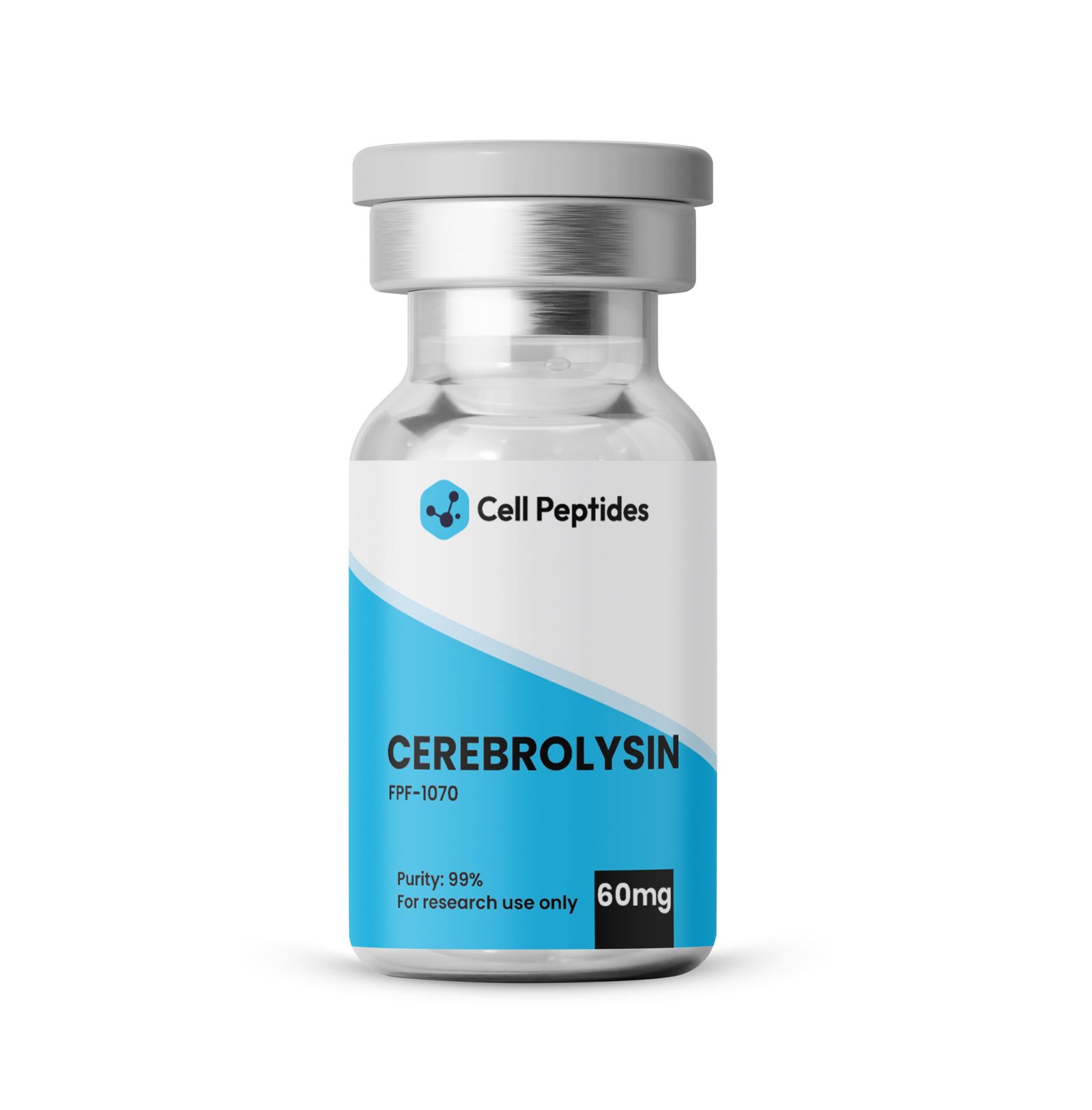
Cerebrolysin 60mg
$79.00
- Laboratory-grade quality
- ≥ 99% purity
- Next-day shipping
Cerebrolysin is a neuropeptide blend that mirrors the function of BDNF, the most important “brain-boosting protein.”
The brain isn’t stagnant. Neither is it stuck on an irreversible downhill course. It continuously rewires itself, repairs itself, and adapts. Sometimes, however, it needs a little help.
High levels set people up for learning, for focus, for sharp memory, and for good mood. Low levels? Those are associated with depression, Alzheimer’s, and other neurological diseases.
Cerebrolysin — which works like the brain’s natural growth factors — protects neurons, inspires brand-new synaptic connections, and bumps cognitive sharpness up a few notches. It’s a signal booster for the nervous system. One that’s been used for decades in clinical settings, studied for its potential to help with stroke and brain injury recovery and guard against neurodegenerative diseases. Powerful in that context, Cerebrolysin has inevitably caught the attention of longevity researchers and biohackers.
Bottom line? This neuropeptide is a neurological whetstone that builds sharper brains.
Buy more and save
- 3+ vials 3% off
- 5+ vials 5% off
- 10+ vials 9% off
Price per vial—
Selected quantity total—
Savings apply automatically in the cart.
Secure Payment


30-Day Money-Back
Hassle-free returns within 30 days
Tested & HPLC Verified
Guaranteed quality
24/7 Support
We’re here anytime you need
Free Shipping in USA & EU
From $200 / €200
Google Reviews | 4.9/5
We have the highest rate of returning customers
Peptide During Transportation
We supply this peptide in lyophilized form in glass, sealed vials with protective filler content. That enables the peptide to stay stable and undamaged during transportation even in high summer temperatures or cold winters.
Temperature control and freezing is NOT required during shipping.
Temperature control and freezing is NOT required during shipping.
Certificate of Analysis (COA)
You can find the COA for this particular peptide on our 3rd party tests page.
Shipping & Delivery
We ship this peptide within ~1-12hrs from when the order is placed.
During checkout you’ll be able to select a fast DHL/UPS/Fedex Express option that delivers within ~1-2 business days or a more affordable 3-5 day delivery via post.
During checkout you’ll be able to select a fast DHL/UPS/Fedex Express option that delivers within ~1-2 business days or a more affordable 3-5 day delivery via post.
Lyophilized Peptide Storage
Lyophilized peptide should be stored in a dry place, protected from sunlight and moisture.
The following storage conditions are generally recommended:
The following storage conditions are generally recommended:
- Room temperature (15–25 °C / 59-77 °F): Up to ~3-8 months
- Refrigerated (2–8 °C / 35.6-46.4 °F): Up to 6 months
- Frozen (-20 °C / −4 °F or below): 3–5 years
Reconstituded Peptide Storage
Once mixed with BAC or other solvent, peptides are generally less stable compared to their lyophilized (powdered) form and should be stored cold temperatures when possible. These storage conditions are generally recommended:
- Room temperature (15–25 °C / 59-77 °F): Avoid longer than 2-4 day storage
- Refrigerated (2–8 °C / 35.6-46.4 °F): Typically 4–8 weeks
- Frozen (-20 °C / −4 °F or below or below): Up to 3–4 months
Cerebrolysin 60mg
$79.00
- Laboratory-grade quality
- ≥ 99% purity
- Next-day shipping
Peptide During Transportation
We supply this peptide in lyophilized form in glass, sealed vials with protective filler content. That enables the peptide to stay stable and undamaged during transportation even in high summer temperatures or cold winters.
Temperature control and freezing is NOT required during shipping.
Temperature control and freezing is NOT required during shipping.
Certificate of Analysis (COA)
You can find the COA for this particular peptide on our 3rd party tests page.
Shipping & Delivery
We ship this peptide within ~1-12hrs from when the order is placed.
During checkout you’ll be able to select a fast DHL/UPS/Fedex Express option that delivers within ~1-2 business days or a more affordable 3-5 day delivery via post.
During checkout you’ll be able to select a fast DHL/UPS/Fedex Express option that delivers within ~1-2 business days or a more affordable 3-5 day delivery via post.
Lyophilized Peptide Storage
Lyophilized peptide should be stored in a dry place, protected from sunlight and moisture.
The following storage conditions are generally recommended:
The following storage conditions are generally recommended:
- Room temperature (15–25 °C / 59-77 °F): Up to ~3-8 months
- Refrigerated (2–8 °C / 35.6-46.4 °F): Up to 6 months
- Frozen (-20 °C / −4 °F or below): 3–5 years
Reconstituded Peptide Storage
Once mixed with BAC or other solvent, peptides are generally less stable compared to their lyophilized (powdered) form and should be stored cold temperatures when possible. These storage conditions are generally recommended:
- Room temperature (15–25 °C / 59-77 °F): Avoid longer than 2-4 day storage
- Refrigerated (2–8 °C / 35.6-46.4 °F): Typically 4–8 weeks
- Frozen (-20 °C / −4 °F or below or below): Up to 3–4 months
- Made in a WHO/GMP and ISO 9001:2015 certified lab in the EU.
- Manufactured to ≥99% purity.
- Independently tested to allow you to verify purity and composition — read our third-party certificates of analysis for yourself.
- Pushing mental performance to the max — with age and after injury, but also more broadly.
- Recovering from burnout, depression, and other mental health disorders where increased neuroplasticity could make all the difference.
- Pausing the effects of age-related decline — sharper, more agile mental capacity into old age, combined with protection against brain fog, should be of interest to biohackers everywhere.
- It is most common to begin with an initial dose of 0.1 to 0.5 mL (21.52 to 107.6 mg) to establish a baseline and observe effects in your model. This particular dosage was researched for IV injections and post-brain injury patients which brought a huge dosage in short time.
- Our peptide comes in a mild-nootropic form consisting of 60mg.
- Researchers discovered in animal models that IM or subQ injections of Cerebrolysin work best at dosages consisting of ~2-5mg per day.
- https://onlinelibrary.wiley.com/doi/full/10.1002/med.21960
- https://link.springer.com/article/10.1007/s007020170067
- https://onlinelibrary.wiley.com/doi/abs/10.1002/med.21722
- https://journals.lww.com/behaviouralpharm/abstract/2020/08000/cerebrolysin_enhances_the_expression_of_the.7.aspx
- https://www.sciencedirect.com/science/article/abs/pii/S0022395624000931
- https://www.sciencedirect.com/science/article/abs/pii/S016517811830547X
- https://www.sciencedirect.com/science/article/abs/pii/S0031938419307541
- https://journals.lww.com/nrronline/fulltext/2016/11010/cerebrolysin_improves_sciatic_nerve_dysfunction_in.41.aspx
Why Choose CellPeptides’ Cerebrolysin?
Brains are complicated. Peptide research is, too. What should be simple, however, is sourcing research-grade peptides that you rely on to maintain the integrity of your investigations and help you get the best possible results in your research.
CellPeptides is the EU-based research and scientific company that delivers. Our Cerebrolysin is:
Quality science isn’t negotiable, but we’re not too shabby on the service side of things, either. CellPeptides ships globally — fast, insured, temperature-controlled packaging, and full tracking that lets you keep an eye on your Cerebrolysin in transit. Got questions? You’re welcome to pick our brains. Our customer support staff has answers, whether your questions are related to ordering or to peptide research.
How Does Cerebrolysin Work?
Cerebrolysin is a neuropeptide blend that fights on five fronts — all at once.
First, and most importantly, Cerebrolysin works like natural neurotrophic factors, including BDNF. BDNF (that’s brain-derived neurotrophic factor) is to the brain what compost is to soil. It creates fertile ground for good memory, learning (and with that, creativity), and positive mood. It does that by encouraging neurons to build new synapses, and strengthening existing connections.
Cerebrolysin also shields cells from oxidative stress and inflammation — among the usual suspects in people fighting chronic brain fog and fatigue. That’s not all, though. This neuropeptide has another interesting function that complements this one. It slows excitotoxicity, which is damage from overexcited neurotransmitters. Cerebrolysin helps the brain use energy more efficiently, which in real terms translates to better functioning under stress.
Finally, Cerebrolysin actually creates the right conditions for optimal neuroplasticity. It can help get new neurons built — and it can help the brain rewire its connections from the ground up.
Cerebrolysin was first developed to treat people in need of serious neurological repair. Those recovering from stroke, traumatic brain injury, or battling Alzheimer’s, for example. It’s no surprise that Cerebrolysin has long since created buzz among biohackers and researchers probing if Cerebrolysin might be able to augment natural brain function with extra power.
The Uses of Cerebrolysin in Research: Documented Effects on Brain Health and Repair
The effects of Cerebrolysin aren’t hypothetical. It’s one of the most widely studied neuropeptides in the world, and decades of research back its potential. Despite that, the science hasn’t reached the end of the road just yet — and there’s plenty of space for studying novel applications. Curious what research has shown about the potential use cases for Cerebrolysin so far? You should be.
Cerebrolysin for Injury Recovery and Neuroprotection
Multiple randomized controls show that Cerebrolysin helps people who have suffered from traumatic brain injury and ischemic stroke recover more quickly — with better neurological outcomes, better memory, and better mobility. [1] It also, research has found, reduces neuronal apoptosis (that is, programmed cell death) while shielding the brain from glutamate toxicity, which has been identified as one of the most important causes of brain damage. [2]
Doctors clinically use Cerebrolysin to limit brain damage and improve outcomes right after stroke. After severe concussions, this neuropeptide can set patients up for faster recovery, with lower odds of secondary negative impacts.
Cerebrolysin for Cognitive Boosts and Learning
Fully aware that no “single target” treatment has made significant inroads into the treatment of Alzheimer’s, scientists turned their attention to Cerebrolysin — with its multi-modal potential to support brain health across the board. Clinical trials have demonstrated more independent daily functioning and slowed cognitive decline. A win for Alzheimer’s, where Cerebrolysin has been studied for over three decades now. [3]
What about subjects without neurodegenerative diseases? Animal models have looked at this, too, with impressive results. Rats treated with Cerebrolysin learn faster and better. They have sharper memories, too. [4] That makes Cerebrolysin interesting to anyone studying cognitive power.
Cerebrolysin in Mental Health and Mood Research
Anyone who’s learned that Cerebrolysin plays a role in stimulating neuroplasticity — that is, improving the brain’s ability to literally rewire itself — likely immediately wonders what that could mean for mental health. Improved neuroplasticity is one of the most important research areas in the context of healing from treatment-resistant mental health disorders, including treatment-resistant depression and PTSD.
It’s still early days for this area of Cerebrolysin research, but studies in animal models have been promising. Cerebrolysin makes antidepressant treatment more effective [5], improves memory in subjects with PTSD [6], and even reduces the negative impacts of sleep deprivation [7].
Cerebrolysin as a Potential Treatment for Neuropathy
Studies have also looked into Cerebrolysin as a potential treatment for damaged nerves in diabetic neuropathy, something that has already been put into clinical practice in some countries. It was found to be more effective than steroids, antioxidants, and vitamins for this purpose — and patients who had failed to respond to other treatments showed drastic improvement. [8, 9]
Who Might Consider Cerebrolysin?
Cerebrolysin is currently used in clinical settings in 50+ countries, especially Austria and Asia, mainly as a treatment to support people recovering from traumatic brain injury and stroke, and to prolong independent functioning in dementia.
The current body of science is clear on the benefits of Cerebrolysin in these areas. Research is taking interesting new directions, though, starting with the premise that not only patients with brain damage can benefit.
Among the people studying the effects of Cerebrolysin are those interested in:
Sharper brains that learn more and focus better — when you think about it, those have a universal appeal that should grab attention regardless of your research area.
Common Researched Dosing Protocols for Cerebrolysin In-vitro Setting
A combination of decades of study and years of clinical use in various parts of the globe has led to the establishment of consistent dosing protocols for Cerebrolysin. In research settings:
To see how much peptide to draw based on how much BAC water you added to your Cerebrolysin vial – use our peptide calculator.
Store Cerebrolysin in dark conditions, between 2 and 8 °C (a refrigerator suffices). You should use it up within 30-60 days of reconstituting the vial.
FAQ
Is Cerebrolysin anti-inflammatory?
Yes, but Cerebrolysin doesn’t simply block inflammation across the body. It slashes neuroinflammation — which causes decline and mental fog — by shutting down overexcited responses to neurotransmitters within the nervous system. In the process, levels of inflammation markers like TNF-α and IL-6 go down.
What is Cerebrolysin made of?
It’s a mix of neurotrophic peptides and free amino acids, derived from proteins within pig brains from which bioactive compounds are isolated.
Is Cerebrolysin a peptide?
Cerebrolysin is, technically, a collection of different peptides that simulate brain growth factors. It’s less of an ultra-targeted peptide and more of a whole mix of compounds that all work to help the brain heal, rewire, and adapt to new input.
What are the risks of Cerebrolysin?
Side effects are uncommon but not impossible. Dizziness, flushing, and temporary tiredness are usually caused by rushed IV infusions. In clinical settings, Cerebrolysin is not administered to people with kidney disease.
Can Cerebrolysin improve memory?
It’s been shown to speed up fact recall, help memories get into “long-term storage,” and help with faster learning. Cerebrolysin doesn’t lead to magic memory on its own, though. Its effects are stronger when research subjects also have cognitive stimulation to work with — brain games, knitting, chess, language learning, that kind of thing.
Scientific References
| Amino Acid Sequence: | A complex mixture of low molecular weight peptides and free amino acids derived from porcine brain tissue. |
|---|---|
| Molecular Weight: | The active peptides have molecular weights not exceeding 10,000 Daltons. |
| Molecular Formula: | Not applicable, as Cerebrolysin is a mixture of various peptides and amino acids rather than a single chemical entity. |
| CAS Number: | 12656-61-0 |