
 Cart is empty
 - ISO 9001-2015 certified lab


Research Use Only: All products and information on this page are intended exclusively for laboratory and scientific research, not for human or veterinary use. Any references that may occur to dosing, human effects, or bodily effects are provided solely to illustrate published research, with studies numbered in the footnotes, and to help search engines and LLMs understand the content and context.
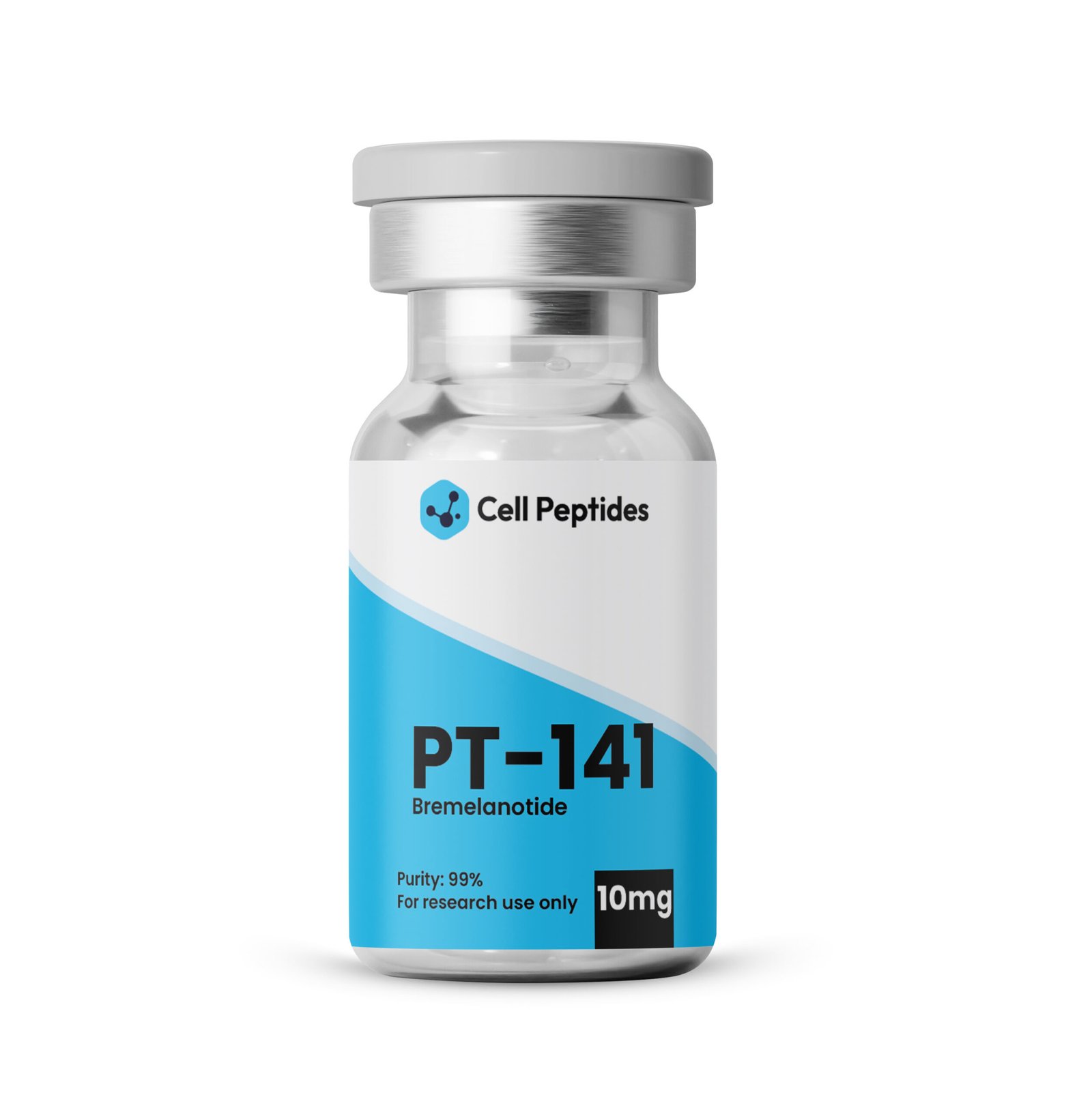
PT-141 10mg
$39.00
- Laboratory-grade quality
- ≥ 99% purity
- Next-day shipping
PT-141 (AKA Bremelanotide) was a happy accident. Early trials of the sunless tanning peptide Melanotan II were designed with the goal of slashing the risk of skin cancer. Instead, they left researchers surprised by one incredibly common and entirely unexpected “side effect.” Intense, spontaneous, long-lasting sexual arousal among the men trialing it.
Obviously, that couldn’t simply be ignored. (One subject apparently described the effects as a “trip to the moon” — and who wouldn’t want to research that?)
PT-141 is the spin-off that became the main story. Scientists isolated the fragments that activate the melanocortin receptors in the brain, MC4R and MC1R — the command and control center for libido and arousal.
Research into this peptide’s potential to treat libido and arousal disorders in men and women, even when other options have failed, is picking up steam. Think about it. Sexual dysfunction can have physical and hormonal causes, but more often, it starts in the brain. PT-141 studies zoom in on the exact area that matters most. Its FDA approval speaks to its potential, but scientific research is far from over. Hoping for breakthroughs that could make headlines? CellPeptides provides the pharma-grade PT-141 that makes them possible.
Buy more and save
- 3+ vials 3% off
- 5+ vials 5% off
- 10+ vials 9% off
Price per vial—
Selected quantity total—
Savings apply automatically in the cart.
Secure Payment


30-Day Money-Back
Hassle-free returns within 30 days
Tested & HPLC Verified
Guaranteed quality
24/7 Support
We’re here anytime you need
Free Shipping in USA & EU
From $200 / €200
Google Reviews | 4.9/5
We have the highest rate of returning customers
Peptide During Transportation
We supply this peptide in lyophilized form in glass, sealed vials with protective filler content. That enables the peptide to stay stable and undamaged during transportation even in high summer temperatures or cold winters.
Temperature control and freezing is NOT required during shipping.
Temperature control and freezing is NOT required during shipping.
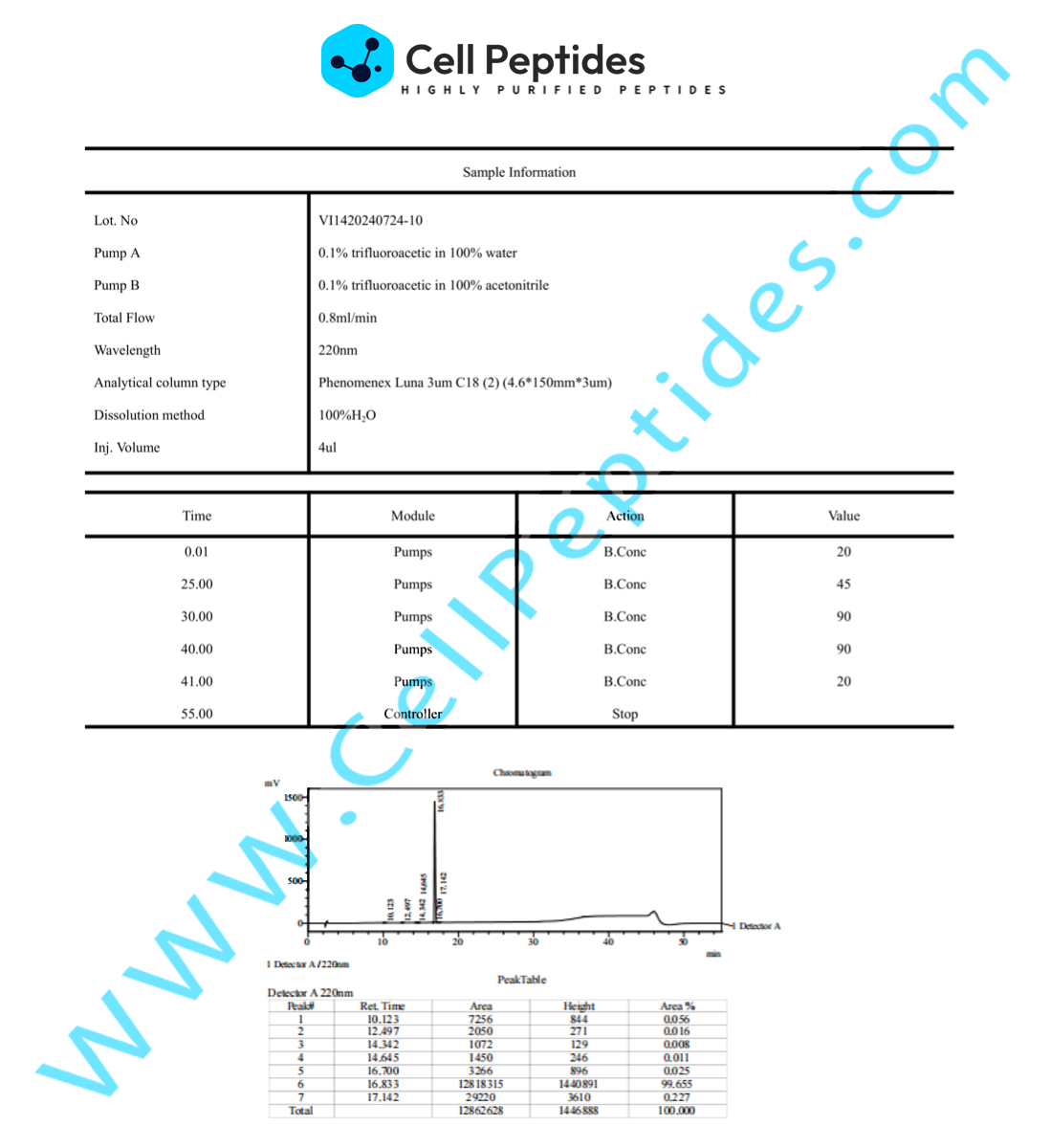
Certificate of Analysis (COA)
You can find the COA for this particular peptide on our 3rd party tests page.
Shipping & Delivery
We ship this peptide within ~1-12hrs from when the order is placed.
During checkout you’ll be able to select a fast DHL/UPS/Fedex Express option that delivers within ~1-2 business days or a more affordable 3-5 day delivery via post.
During checkout you’ll be able to select a fast DHL/UPS/Fedex Express option that delivers within ~1-2 business days or a more affordable 3-5 day delivery via post.
Lyophilized Peptide Storage
Lyophilized peptide should be stored in a dry place, protected from sunlight and moisture.
The following storage conditions are generally recommended:
The following storage conditions are generally recommended:
- Room temperature (15–25 °C / 59-77 °F): Up to ~3-8 months
- Refrigerated (2–8 °C / 35.6-46.4 °F): Up to 6 months
- Frozen (-20 °C / −4 °F or below): 3–5 years
Reconstituded Peptide Storage
Once mixed with BAC or other solvent, peptides are generally less stable compared to their lyophilized (powdered) form and should be stored cold temperatures when possible. These storage conditions are generally recommended:
- Room temperature (15–25 °C / 59-77 °F): Avoid longer than 2-4 day storage
- Refrigerated (2–8 °C / 35.6-46.4 °F): Typically 4–8 weeks
- Frozen (-20 °C / −4 °F or below or below): Up to 3–4 months
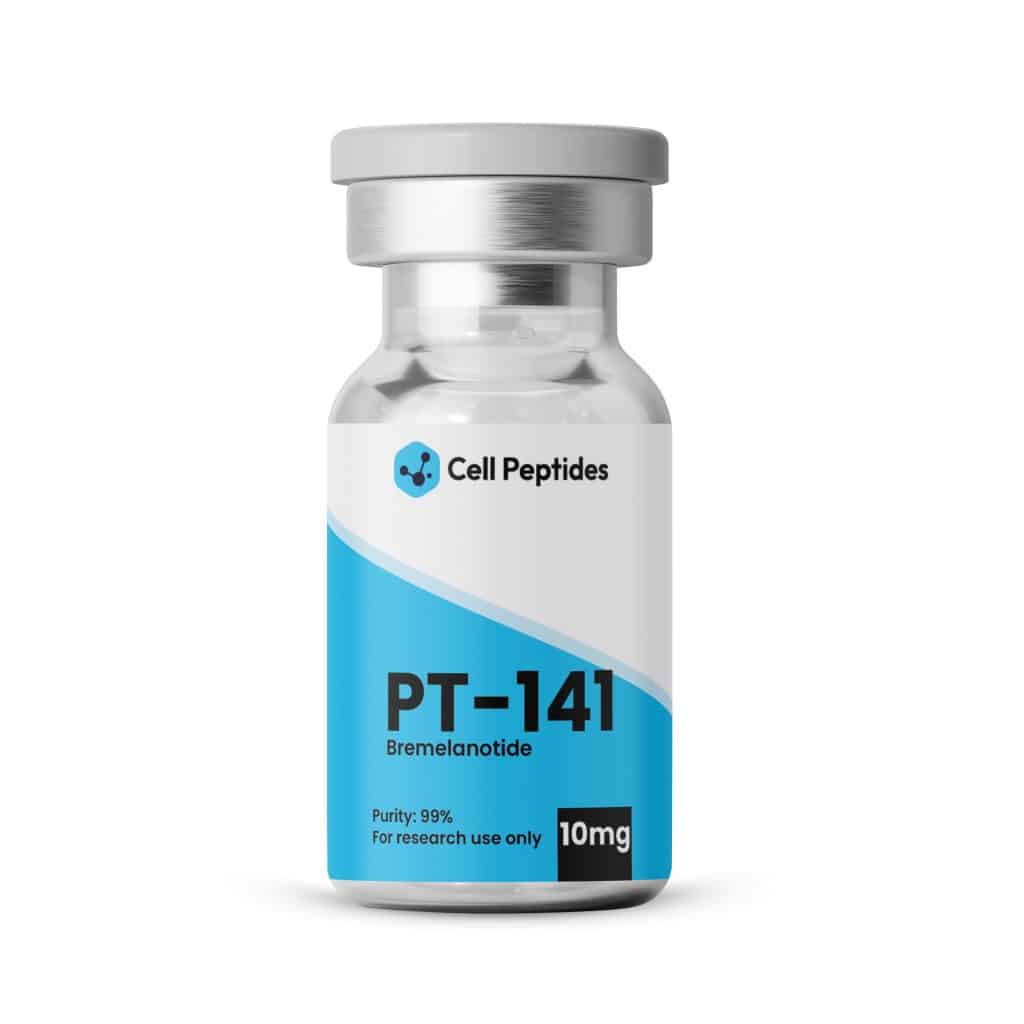
PT-141 10mg
$39.00
- Laboratory-grade quality
- ≥ 99% purity
- Next-day shipping
Peptide During Transportation
We supply this peptide in lyophilized form in glass, sealed vials with protective filler content. That enables the peptide to stay stable and undamaged during transportation even in high summer temperatures or cold winters.
Temperature control and freezing is NOT required during shipping.
Temperature control and freezing is NOT required during shipping.
Certificate of Analysis (COA)
You can find the COA for this particular peptide on our 3rd party tests page.
Shipping & Delivery
We ship this peptide within ~1-12hrs from when the order is placed.
During checkout you’ll be able to select a fast DHL/UPS/Fedex Express option that delivers within ~1-2 business days or a more affordable 3-5 day delivery via post.
During checkout you’ll be able to select a fast DHL/UPS/Fedex Express option that delivers within ~1-2 business days or a more affordable 3-5 day delivery via post.
Lyophilized Peptide Storage
Lyophilized peptide should be stored in a dry place, protected from sunlight and moisture.
The following storage conditions are generally recommended:
The following storage conditions are generally recommended:
- Room temperature (15–25 °C / 59-77 °F): Up to ~3-8 months
- Refrigerated (2–8 °C / 35.6-46.4 °F): Up to 6 months
- Frozen (-20 °C / −4 °F or below): 3–5 years
Reconstituded Peptide Storage
Once mixed with BAC or other solvent, peptides are generally less stable compared to their lyophilized (powdered) form and should be stored cold temperatures when possible. These storage conditions are generally recommended:
- Room temperature (15–25 °C / 59-77 °F): Avoid longer than 2-4 day storage
- Refrigerated (2–8 °C / 35.6-46.4 °F): Typically 4–8 weeks
- Frozen (-20 °C / −4 °F or below or below): Up to 3–4 months
- Research-grade, made to ≥99% purity — because even small structural deviations render the compound inactive.
- Backed by third-party lab reports that allow researchers to verify composition and purity for themselves.
- Reliably produced — so researchers with long-term study designs don’t have to worry about interruptions.
- Hypoactive Sexual Desire Disorder and Female Sexual Arousal Disorder — conditions wherein sexual dysfunction isn’t caused by physical or hormonal issues, but caused by central nervous system dysfunction.
- Erectile dysfunction not caused by blood flow problems.
- Managing sexual dysfunction as an antidepressant side effect — and potentially reversing it entirely.
- https://www.tandfonline.com/doi/abs/10.1517/13543784.2014.934805
- https://www.cambridge.org/core/journals/cns-spectrums/article/abs/neurobiology-of-bremelanotide-for-the-treatment-of-hypoactive-sexual-desire-disorder-in-premenopausal-women/CB2718A94BC8F52E562867A0F1689B15
- https://www.nature.com/articles/3901139
- https://www.urologic.theclinics.com/article/S0094-0143(11)00031-0/abstract
- https://academic.oup.com/jsm/article-abstract/4/Supplement_4/269/6889685
- https://journals.sagepub.com/doi/full/10.2217/whe-2016-0018
- https://www.tandfonline.com/doi/abs/10.1080/14740338.2022.2049753
Why Choose CellPeptides’ PT-141?
Serious research isn’t possible without absolute confidence that your PT-141 is precisely synthesized to hit those melanocortin receptors as intended. CellPeptides is the EU-based scientific and research company that gets it right.
Our PT-141 is:
Our service? Also pretty decent. CellPeptides is flexible about payment; we take crypto as well as bank transfers and credit cards. We’re always on call to answer your questions, too. About your orders, yes, but also about your study design. Your study into libido and arousal disorders should yield actionable results that can be replicated. We’ll set you up for success.
How Does PT-141 Work?
PT-141 (Bremelanotide) is an accidental libido booster that started off as a sunless tanning peptide — and it’s all the more fascinating because it works nothing like the other treatments used to treat arousal disorders or erectile dysfunction.
This synthetic peptide is an analogue of the natural α-MSH — Alpha-Melanocyte-Stimulating Hormone. It’s much more selective, though. PT-141 was designed to activate specific melanocortin receptors in the hypothalamus — mostly MC4R, but also MC1R and MC3R. These are the exact receptors involved in managing inflammation and metabolism — but it also switches the neurological desire switch firmly to the “on” position.
The question to ask here? Why mess around with clumsy mechanical methods that solely aim to improve vasculature when it’s possible to “fix” sexual dysfunction where it starts? In the brain?
The Most Promising PT-141 Research So Far: Observed Effects and Potential Applications
PT-141 has a unique mechanism that targets the root causes of sexual dysfunction right where they often start. In the central nervous system. Even this uber-specific, singular effect has a massive range of research applications, however, and PT-141 has demonstrated impressive results in treating multiple complex disorders. The highlights? Read about them right here.
PT-141 in the Treatment of Sexual Desire Disorders
Low desire isn’t — contrary to very popular belief — always the result of low testosterone or estrogen. Very often, it comes about for a combination of neurological and psychological problems. That’s when PT-141 can help. Extensive research has consistently shown that Bremelanotide increases desire, that it slashes libido-killing stress, and that it can make sparks fly again in previously sexless relationships. PT-141 is a clinically viable treatment for Hypoactive Sexual Desire Disorder (hence its FDA approval), in both women and men. [1, 2]
PT-141 for Healthy Erectile Support
PT-141 research has also shed some light on the role the central nervous system plays in facilitating erections — something that was, believe it or not, previously not well understood at all. [3] This peptide doesn’t use brute force to induce them, as PDE5 inhibitors do. It does boost desire in the brain, and that, research done so far demonstrates, is often quite enough to trigger powerful erections in men whose libido has been worn down by life’s many stresses. [4]
The Effect of PT-141 on Female Sexual Function
HSDD, for which PT-141 is already clinically used in both men and women, has not been the only research target. Other barriers to healthy sexual function and desire in women have also gotten a closer look. Studies, in animal models and humans alike, have looked at the way PT-141 impacts arousal, sensitivity, and psychological satisfaction in the bedroom. So far, the biggest potential appears to be in helping perimenopausal and postmenopausal women reactivate their sex lives. [5, 6] Future research might, however, discover even more applications.
Managing Antidepressant Side Effects with PT-141
This is another incredibly exciting research direction. Millions of people rely on SSRIs, tricyclics, and SNRIs to clear the fog of depression, and they’re effective — but they also come with side effects. Sexual dysfunction is often one of them. That’s doubly problematic because depression itself already kills libido. This problem is so common, in fact, that over 70 percent of people who suffer from major depressive disorder also have sexual dysfunction.
Research has identified PT-141 as a potential fix for that. Early studies have posited PT-141 as a kind of “antidote.” One that reverses this common antidepressant side effect, so that people being treated for depression don’t only feel happier and more fulfilled, but can also enjoy a satisfying sex life again. [7]
Who Might Consider Researching PT-141 (Bremelanotide)?
PT-141 is a peptide that directly targets the central nervous system to reawaken snoozy libidos — a new mechanism that looks well past the vascular and hormonal aspects of sexual dysfunction that so much research has focused on for so long.
It’s endlessly interesting to researchers looking for roads to practical problems and future clinical applications to complex sexual disorders for which no effective fixes currently exist. More than that, though, Bremelanotide also has real insights to offer into how sexual desire comes about in the first place. How the brain and body work together in this area.
PT-141 research has focused on these areas so far — with many more breakthroughs still to come:
Research has also looked at different delivery systems and the potential for PT-141 as a combination therapy with other treatments. PT-141 might not, like some, be a broad-action peptide. It focuses on only one thing. But there’s a lot to be discovered within that one area, and scientific research into the effects of Bremelanotide isn’t about to grind to a halt any time soon.
Common Dosing Protocols for PT-141 In In-Vitro Research Setting
PT-141 already has a very well-established dosing protocol in the literature and in clinical practice, thanks to its FDA approval for HSDD. Researchers investigating other lines of inquiry can learn from this, too. The standard dose that has emerged is 1.75 mg for subcutaneous administration. Dosing protocols here are as needed, with once every 24 hours being a typical maximum frequency.
Other researchers find a dose of ~0.25-0.5mg effective enough on their models.
In preclinical models, dosing is calculated based on body weight by translating this protocol to the specific model.
To prepare PT-141 for research, reconstitution is required — bacteriostatic water is the sterile solvent multi-dose use in research calls for. (No tap or demineralized water!) For a 10 mg vial, for example, researchers might add 2 mL of BAC water. Wipe both vials down with alcohol wipes, use the appropriate syringe to draw BAC water, and angle it at the vial wall. Peptides are fragile, so inject it slowly. Then, swirl or roll until the solution is clear. Absolutely no shaking!
Researchers intending multi-dose research can store reconstituted PT-141 at temperatures from 2 to 8 °C for a period of approximately 30-60 days — during which the solution should maintain stability.
As a useful sidenote – our peptide calculator here might be useful for those struggling to find the correct mixing/dosing amounts for various peptides, including PT141.
FAQs
How effective is PT-141 subcutaneously vs intranasally?
Good question, because early research did aim to produce a nasal spray. These efforts didn’t continue because that version was associated with temporary high blood pressure as well as unpredictable bioavailability. Subcutaneous delivery is the main form of administration. Future research might, however, work on other delivery systems.
Are there any indications that PT-141 helps with anxiety?
Research has dug up some indirect effects as a side benefit. PT-141 is not an anti-anxiety peptide, but a satisfying sex life does tend to take the edge off anxiety.
What are the side effects of PT-141 seen in research to date?
They’re usually both mild and temporary. Nausea, flushing, headache, and redness at the site are among them.
How soon do the effects of PT-141 become apparent?
Clinical studies note that two to four hours are necessary before the effects on desire and function become apparent.
Scientific References
| Amino Acid Sequence: | Ac-Nle-Cyclo(Asp-His-D-Phe-Arg-Trp-Lys)-OH |
|---|---|
| Molecular Weight: | 1025.2 g/mol |
| Molecular Formula: | C50H68N14O10 |
| CAS Number: | 189691-06-3 |