 Cart is empty
Current laboratory research on hypertrophy, cellular recovery and the growth hormone (GH) axis, has one of its main objectives in identifying the best peptides for muscle hypertrophy.
This ranking list considers the 8 most studied peptide compounds in 2026 for muscle hypertrophy, growth hormone activation, and tissue regeneration.
The chemicals are ranked on the strength of the science behind them, according to their unique mode of action rather than cost. These are exclusively laboratory substances designated for in-vitro and animal study, not for use as dietary supplements. They are not for human use.
What to Look for in Bodybuilding Research Peptides
Before we dive into the best peptides for muscle hypertrophy, it’s important to outline the strict criteria by which these substances are judged. In clinical and laboratory settings, the following features are important in researchers’ choice of research peptides:
- Evidence Quality: Peptide selection is guided by high quality evidence from rigorous peer reviewed studies, particularly in preclinical animal models and, when available, early human data.
- Peptide Category: Different collections of molecules for different research purposes. Growth Hormone Secretagogues (GHRPs and GHRHs) are about stimulating endogenous growth hormone, IGF-1 analogues are about directly impacting hypertrophy, and healing peptides are about tissue repair. [1]
- Purity and Verification: For meaningful experimental results, the best injectable peptides for muscle growth should have a minimum purity of ≥97%, verified by HPLC testing, and supplied with a Certificate of Analysis (CoA).
- Administration Route: The experimental procedures differ significantly depending on the bioavailability. Injectables are the standard, but if you’re interested in learning more about the oral delivery methods, you can check out our /oral-peptides-for-muscle-growth/.
- Stack Compatibility: Certain drugs have a lot of synergy. Understanding how GHRHs and GHRPs interact is important for researchers interested in optimising production of endogenous hormones.
8 Best Peptides for Muscle Growth: Quick Comparison Table
Most effective peptides for muscle growth by classification, primary research application and specific effects on growth hormone axis and recovery. These are the top peptides for bodybuilding research on the market today.
| # | Peptide | Class | Primary Research Use | GH Effect | Recovery Effect | Best For |
| 1 | CJC-1295 w/ DAC | GHRH | Sustained GH stimulation | High | Indirect | GH-axis research |
| 2 | Ipamorelin | GHRP | Clean GH pulse | High | Indirect | GH + low side-effect profile |
| 3 | BPC-157 | Healing peptide | Tissue & muscle repair | None | High | Recovery research |
| 4 | TB-500 | Healing peptide | Systemic regeneration | None | High | Soft tissue repair |
| 5 | GHRP-6 | GHRP | GH + appetite signalling | High | Indirect | GH + anabolic signalling |
| 6 | Hexarelin | GHRP | Potent GH stimulation | Very High | Indirect | Max GH output studies |
| 7 | Sermorelin | GHRH | Mild GH stimulation | Moderate | Indirect | Entry-level GH research |
| 8 | PEG-MGF | IGF-1 variant | Satellite cell activation | None | Moderate | Hypertrophy research |
The 8 Best Peptides for Muscle Growth – Full Breakdown
In this document, we dive into each molecule in detail, explaining how it works, what it is used for in research, and why they are considered the best peptides for muscle gain currently in 2026.
1. CJC-1295 w/ DAC – Best for Sustained GH Stimulation Research
Best for: Researchers investigating sustained stimulation of the GH/IGF-1 axis
CJC-1295 with DAC is a heavily modified form of Growth Hormone-Releasing Hormone (GHRH). By binding to serum albumin, the DAC inclusion greatly extends the peptide’s half-life and protects it from rapid enzymatic degradation. In both clinical and pre-clinical trials this drug has been shown to be able to produce sustained pulsatile growth hormone secretion, mimicking normal physiological pulsatility without persistent receptor overstimulation [2].
This ongoing increase makes it the top reported GHRH in performance peptide studies. CJC-1295 With DAC provides a sustained IGF-1 increase, which is good for labs looking for long-term hypertrophy, cellular repair, and systemic anabolism. It is often used in synergistic research with a GHRP such as Ipamorelin to look at cumulative effects on the pituitary gland. This peptide is often used as a basis for growth hormone axis research when scientists are evaluating the best peptides for muscle hypertrophy and recovery.
2. Ipamorelin – Best for Clean GH Pulse with Minimal Off-Target Effects
Ipamorelin is distinguished by its superior selectivity over previous GHRPs. It promotes a large and fast secretion of growth hormone without causing significant increases in cortisol, prolactin or appetite (gastric motility). [3] It is one of the most selective GHRPs that has been studied in modern endocrinology due to its ability to avoid off-target hormonal fluctuations. Muscle growth is what Ipamorelin is most efficient at, and researchers keep finding few confounding influences. CJC-1295 and Ipamorelin are the most used GHRH/GHRP research stack which gives the significant information on the synergistic activation of somatotroph cells.
3. BPC-157 – Best for Muscle, Tendon & Ligament Recovery Research
BPC-157 (Body Protection Compound-157) is a synthetic pentadecapeptide derived from a protective protein sequence naturally occurring in human gastric juice. It doesn’t stimulate growth hormone, but it is fundamental in research on muscle and tissue repair. Studies on animals in the preclinical setting demonstrate its unique ability to accelerate healing of torn muscles, ruptured tendons, and damaged ligaments.
This is primarily the activation of growth factors, especially for the stimulation of angiogenesis and collagen production at the site of injury. [4] BPC-157 is an important data point for labs that are looking at the best peptides to use for healing and muscle hypertrophy following acute mechanical injury. It is important to mention that the evidence available is mostly preclinical, but its effectiveness in cellular repair models makes it one of the most studied healing peptides in the world.
4. TB-500 (Thymosin Beta-4) – Best for Systemic Recovery & Regeneration
TB-500 is a synthetic version of a naturally occurring peptide in virtually all human and animal cells, Thymosin Beta-4. Crucial for cellular regeneration, it binds to actin, a vital protein for cellular structure and motility. Research models show that TB-500 increases migration of cells to areas of damage, drastically reduces localized inflammation, and promotes new blood vessel and muscle fiber growth. [5]
With its small molecular weight, TB-500 can show significant systemic mobility, enabling it to move through the bloodstream and reach distant areas of inflammation and tissue damage. It is often studied with BPC-157 due to their synergistic healing effects in models of severe musculoskeletal injury. Researchers are also looking into its role in myogenesis and structural repair, giving more support to the preclinical evidence.
5. GHRP-6 – Best for GH Stimulation + Appetite Signalling Research
GHRP-6 (Growth Hormone-Releasing Peptide-6) is a first generation hexapeptide that activates ghrelin receptors to effectively stimulate the pituitary gland. GHRP-6 not only has potent GH releasing properties but also has a secondary mechanism of action in research circles, that of a notable appetite stimulant. [6] It mimics the action of the hunger hormone ghrelin and induces strong caloric intake behavior in animal models.[7]
This double effect is very useful in research models of bulking phases or cachexia (muscle wasting), where both anabolic hormonal signaling and increased caloric consumption are necessary for hypertrophy. It produces more off-target side effect data (e.g. cortisol elevation) than newer peptides such as Ipamorelin, but is still very useful for comparative studies looking at appetite pathways along with GH output.
6. Hexarelin – Best for Potent GH Output Studies
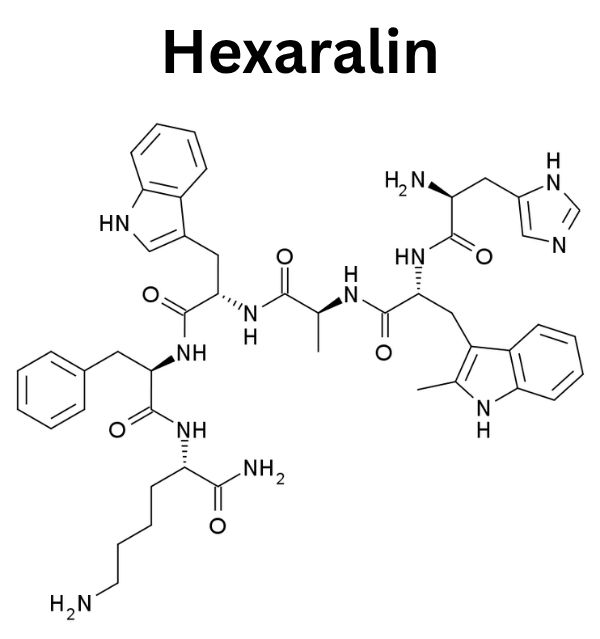
Hexarelin is known to be one of the most powerful GHRPs ever created in the lab. Structurally it is similar to GHRP-6 and it produces a massive acute pulse of growth hormone that will often surpass the output of other secretagogues. Interestingly, apart from its pituitary effect, Hexarelin has been studied for its unique affinity for CD36 receptors in cardiac tissue and demonstrated cardioprotective potential in ischemic research models.[8]
It is very useful in studies where maximum GH output is the primary dependent variable because of its potency. In clinical literature, however, continuous administration of Hexarelin leads to rapid receptor desensitization, with the GH response being blunted faster than gentler compounds. Thus, it is a powerhouse for acute output but it requires carefully cycled protocols in long term study designs.
7. Sermorelin – Best for Mild, Well-Documented GH Stimulation
Sermorelin is a synthetic analogue of the body’s natural Growth Hormone-Releasing Hormone (GHRH), containing the first 29 amino acids of the natural sequence. [9] It offers a mild, very physiological release of growth hormone without disturbing the natural pituitary feedback loops. It has a very well established research profile and broader human safety data than most synthetic GHRPs because it closely mimics natural human biology.
Sermorelin is an excellent reference compound for labs that want to use the best and safest peptides for muscle growth research. It provides a safe, controlled rise in IGF-1 over time, with no risk of extreme hormonal spikes or rapid desensitization, and is an excellent entry-level compound for longitudinal studies on ageing, body composition and lean mass preservation.
8. PEG-MGF – Best for Satellite Cell Activation & Hypertrophy Research
PEGylated Mechano Growth Factor (PEG-MGF) is a unique splice variant of IGF-1. In natural biology, MGF is produced in muscle tissue only in response to mechanical stress or damage (e.g. from heavy resistance training). They attached a polyethylene glycol (PEG) structure to increase its natural half-life from a few minutes to several days, allowing extended experimental observation.
PEG-MGF is strictly a local muscle repair/growth agent. Research emphasizes its important function in stimulating muscle satellite cells (stem cells that are present in muscle tissue) to fuse and form new muscle fibers following tissue injury. [10] It is a key variable in cellular hypertrophy research distinguishing between local growth factor response and systemic GH elevation.
RESEARCH NOTE: The most documented stack in performance peptide research combines CJC-1295 (GHRH) + Ipamorelin (GHRP) for synergistic GH release. Each compound acts on a different receptor, producing a stronger combined GH pulse than either alone.
How to Choose the Right Peptide for Your Research Goals
Ultimately, the best peptide for muscle growth will depend on the specific variables and desired outcomes of the laboratory study. Researchers need to select the right compound class to suit their study objective. Employ this decision framework to direct the selection of compounds:
- Studying GH axis stimulation: Focus on GH secretagogues. Recommended compounds: CJC-1295, Ipamorelin, Sermorelin.
- Studying maximum GH output: Focus on potent GHRPs. Recommended compounds: Hexarelin, GHRP-6.
- Studying hypertrophy / IGF-1 pathway: Focus on IGF-1 variants. Recommended compound: PEG-MGF.
- Studying post-training recovery: Focus on healing peptides. Recommended compounds: BPC-157, TB-500.
- Studying body recomposition (GH + fat loss): Focus on a stack approach. Recommended: CJC-1295 + Ipamorelin. Body recomposition researchers are often looking for the best peptides for muscle growth and fat loss at the same time – see our dedicated guide for that angle at /peptides-for-muscle-growth-and-fat-loss/.
- Female-specific research variables: Navigate to /peptides-for-female-muscle-growth/ for specialized hormonal data.
- Oral administration studies: Navigate to /oral-peptides-for-muscle-growth/ for bioavailability research.
The framework also addresses the difficult question of which peptides are best for lean muscle growth and ensures the correct peptide is used for accurate, unambiguous experimental results.
Safety, Legality & Regulatory Status
When considering the best legal peptides for muscle growth it is important to establish the regulatory & safety reality of these compounds. However, none of these specific peptides are currently approved by the FDA for muscle building, body recomposition or athletic performance enhancement. These are classified as strictly research grade compounds for laboratory use and in-vitro testing only.
There is a lack of long-term human data for the best and safest peptides to induce muscle growth; research should include monitoring for immunogenicity, off-target hormonal effects, and receptor desensitisation. In the athletic arena, the World Anti-Doping Agency (WADA) expressly bans all performance-enhancing peptides in competitive sport.
NOTE: These compounds are not supplements or medications. They are research-grade peptides for in-vitro and laboratory use only. Not for human consumption or personal use.
Takeaways
The eight most effective peptides for muscle growth in 2025 and 2026 fall into three categories: GH secretagogues, IGF-1 variations, and specialized healing peptides. CJC-1295’s sustained elevation and BPC-157’s robust cellular repair are two separate, measurable parameters for lab study. Remember, these are strictly research chemicals, not dietary supplements. See our Peptide Knowledgebase.
Frequently Asked Questions
CJC-1295 and Ipamorelin together constitute the gold standard for researchers wishing to evaluate body recomposition, or the concurrent increase in muscle and reduction in fat. The stack will promote lipolysis through a sustained elevation of GH without the appetite inducing side effects of the likes of GHRP-6 and is perfect for investigating what the best peptides are for weight loss and muscle building.
For a researcher interested in body recomposition, that is, gaining muscle and losing fat, the combination of CJC-1295 and Ipamorelin is considered the gold standard. This stack promotes lipolysis by keeping GH levels high but without the appetite boosting effects that are associated with compounds like GHRP-6, making it perfect to find out which peptides will help you lose weight and build muscle most efficiently.
Models that are researched for female biology tend to lean towards milder and very selective peptides that do not engage in aggressive androgenic pathways or massive prolactin spike. Ipamorelin and Sermorelin are often used because they give a small, physiological GH pulse and are therefore especially applicable to studies on body recomposition in women.
The most effective peptides for muscle hypertrophy are frequently sold as oral supplements, even though actual research peptides are known for their very poor oral absorption. Peptides are strings of amino acids which are rapidly broken down by the acids in your stomach. Therefore, the gold standard in the laboratory still remains injectable administration to guarantee accurate dosage and systemic uptake.
The best synergist combination in lab models is a Growth Hormone-Releasing Hormone (GHRH) with a Growth Hormone-Releasing Peptide (GHRP). The most studied combination is CJC-1295 with Ipamorelin. At the same time, they stimulate two different receptors in the pituitary and increase the release of the body’s own growth hormone and IGF-1.
The choice is a function only of the independent variables of the investigation. Tissue healing is essential to seeing BPC-157. Hexarelin offers a wealth of data for research into maximum acute GH release. PEG-MGF has been used by researchers to activate satellite cells locally without an increase in systemic growth hormone.
References and Studies
[1] Peptides for Bodybuilding: Efficacy, Safety, Types, and More (Healthline) – https://www.healthline.com/nutrition/peptides-for-bodybuilding
[2] Prolonged Stimulation of Growth Hormone (GH) and Insulin-Like Growth Factor I Secretion by CJC-1295, a Long-Acting Analog of GH-Releasing Hormone, in Healthy Adults – https://pubmed.ncbi.nlm.nih.gov/16352683/
[3] Ipamorelin, the First Selective Growth Hormone Secretagogue – https://pubmed.ncbi.nlm.nih.gov/9849822/
[4] Achilles Detachment in Rat and Stable Gastric Pentadecapeptide BPC 157: Promoted Tendon-to-Bone Healing and Opposed Corticosteroid Aggravation – https://pubmed.ncbi.nlm.nih.gov/16583442/
[5] The Actin Binding Site on Thymosin Beta-4 Promotes Angiogenesis – https://pubmed.ncbi.nlm.nih.gov/14500546/
[6] Acute Central Ghrelin and GH Secretagogues Induce Feeding and Activate Brain Appetite Centers – https://pubmed.ncbi.nlm.nih.gov/11751604/
[7] Ghrelin: The ‘Hunger Hormone’ Explained (Healthline) – https://www.healthline.com/nutrition/ghrelin
[8] The Growth Hormone Secretagogue Hexarelin Protects Rat Cardiomyocytes From in vivo Ischemia/Reperfusion Injury Through Interleukin-1 Signaling Pathway – https://pubmed.ncbi.nlm.nih.gov/28321024/
[9] Sermorelin: A Review of Its Use in the Diagnosis and Treatment of Children With Idiopathic Growth Hormone Deficiency – https://pubmed.ncbi.nlm.nih.gov/18031173/
[10] Expression and Splicing of the Insulin-Like Growth Factor Gene in Rodent Muscle Is Associated With Muscle Satellite (Stem) Cell Activation Following Local Tissue Damage – https://pubmed.ncbi.nlm.nih.gov/12692175/