 Cart is empty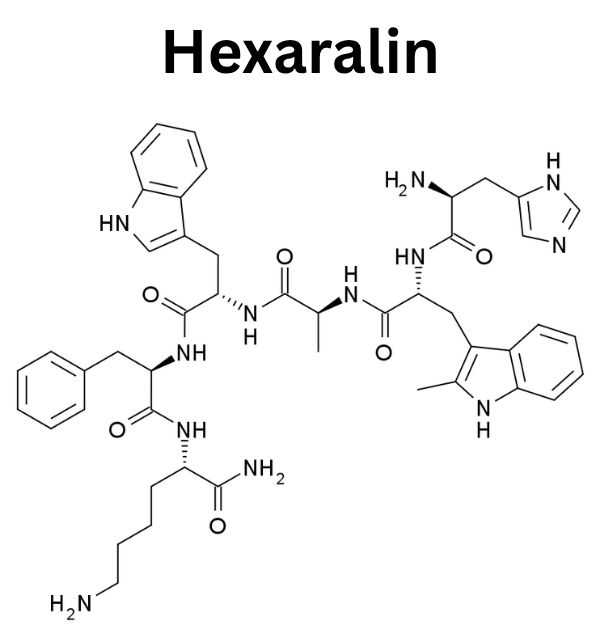
A secretagogue peptide is a peptide that promotes/stimulates the secretion of another hormone/enzyme from a cell/gland. Hexarelin is a synthetic hexapeptide and one of the most potent growth hormone (GH) secretagogues ever studied.
It produces a much bigger growth hormone pulse than GHRP-6 and GHRP-2, two of the leading GH secretagogues, at the same molar dose [12]. And unlike most research peptides, hexarelin was actually tested in people decades ago, so it comes with real (albeit dated and limited) human data [1][2]. By all means, hexarelin is backed by human clinical data, which is more than what could be said for a bunch of other GH-axis research-grade peptides.
And that’s not all. Hexarelin acts through two different receptors. One is for the GH effect and a totally different one for the heart-protective effect (independent of GH) [4].
In this guide, we’ll cover what hexarelin is, how it works, what it’s been studied for, the doses that show up in animal studies, old human trials, as well as biohacking discussions, its side effects, and its legal status in 2026.
What is Hexarelin?
Hexarelin is a hexapeptide (six amino acids) with a sequence of His-D-2-methyl-Trp-Ala-Trp-D-Phe-Lys-NH2, also known as examorelin. It belongs to the GH-releasing peptide (GHRP) family (same family as GHRP-6 and GHRP-2). It was developed by structurally modifying GHRP-6 for greater potency and metabolic stability [12]. A growth hormone secretagogue prompts the body’s own pituitary gland to release GH. It’s not GH itself. And as it has a compact, six-residue structure, it’s relatively resistant to enzymatic breakdown that longer peptides are not.
Now, keep in mind that GHRPs often have a very low oral bioavailability. Hexarelin is no different (generally <1%). Studies often use IV, SC, or intranasal routes. And about those studies. They are old, as we mentioned above, but there’s a key reason for that. Hexarelin emerged in the 1980s-90s during a phase of scientific interest in GHRPs in general. It even reached phase II clinical investigation, but it was never marketed.
How Hexarelin Works
So the pituitary gland and hypothalamus have what we call the “Growth Hormone Secretagogue Receptor” or the GHS-R1a. We haven’t been very creative with its naming. It literally means what it does. This is the receptor that ghrelin binds to. The body naturally produces ghrelin, popularly called the hunger hormone. It’s a peptide produced in one’s stomach and its primary job is to stimulate appetite, basically telling the brain that it’s time to eat. As it turns out, ghrelin also sends a signal to release growth hormone to the pituitary. And this is the action we want to hijack.
Enter hexarelin.
Hexarelin’s primary mechanism is that it binds to the GHS-R1a receptor (instead of allowing more ghrelin to bind to it) in the hypothalamus and anterior pituitary. Once this activation is done, the glands release growth hormone.
Two key things to note here:
- Hexarelin binds to the GHS-R1a receptor, meaning there are fewer binding opportunities for the body’s natural ghrelin. This competitive nature is critical. Hexarelin has a more powerful attachment here. It “turns on” the receptor more intensely than ghrelin can.
- It’s been engineered to have higher binding affinity, slower enzymatic degradation, and a unique ability to suppress somatostatin (the “off” switch for GH). Basically, it’s built to turn GHS-R1a on aggressively, have it produce GH hormone, and sustain these effects for much longer than natural ghrelin can.
That alone is remarkable. It can have the body producing GH for far longer and in a more pronounced way. More GH release directly equates to increased fat burning and building muscle protein (up until a point, it’s beneficial). It also limits glucose uptake to keep fuel available. Naturally, GH spikes during the first hours of night rest, after heavy training sessions, and when insulin rises/blood sugar drops (when fasting, for example).
But that alone isn’t what hexarelin does. It’s got more tricks up its sleeve. Notably:
- Without confusing you with a bunch of biological terms and processes, let us tell you that the downstream effects of hexarelin are also pronounced. One thing leads to another, and ultimately, the GH rise from hexarelin drives a secondary increase in IGF-1.
- When used alongside GHRH, the ultimate GH response is amplified beyond what either of them can achieve (both use different receptors, don’t compete for the same binding sites).
- It blunts somatostatin, another natural peptide in the body that inhibits growth hormone release.
- It also binds to CD36. CD36 is a scavenger receptor on cardiomyocytes and macrophages. This was pinned down by photoaffinity labeling of rat cardiac membranes (Bodart et al., 2002) and confirmed by its absence in CD36-null mice. Through this route, hexarelin offers cardiovascular benefits independent of GH. Basically, hexarelin also activates pro-survival signaling and anti-apoptotic pathways in heart tissue [4].
Main Benefits Hexarelin is Studied For
There are two main camps here. First, you have the GH/IGF-1 axis effects related to muscle, recovery, body composition, etc. Secondly, hexarelin has its cardiovascular protection effects, which, arguably, have a stronger preclinical story backing them.
If GH/IGF-1 increase the way they do due to hexarelin, certain benefits will be (practically speaking, not scientifically) naturally produced in the body, such as body composition and muscle growth effects. In a way, this is all extrapolation. Only the GH release bit is proven with human trials directly.
On the other hand, the cardiovascular findings are based on animal-model data entirely.
Growth Hormone & IGF-1 Stimulation
This is the big one. Most people who talk about hexarelin are likely to be talking about this axis. In a way, this is the core, best-established effect. Hexarelin is known to produce a strong, dose-related GH pulse in healthy as well as GH-deficient humans, with a secondary rise in IGF-1 [1][2]. It’s based on human clinical trials.
This makes hexarelin one of the most potent GHRPs. The pulses are larger than what GHRP-6 and GHRP-2 can produce at equivalent doses [12]. In short children, intranasal hexarelin raised IGF-1 and accelerated linear growth velocity over months of treatment [2]. But the GH response attenuates over time with repeated dosing, desensitizing it [9].
Cardiovascular & Cardioprotective Research
In rat and mouse models, it improved outcomes after cardiac injury, and crucially the effect persists even without GH [4][5]. In rats with no capacity to release GH, hexarelin still protected against ischemia-reperfusion damage [5]. Overall documented effects include reduced infarct size, improved left-ventricular function and ejection fraction, reduced cardiac fibrosis and collagen deposition, and reduced cardiomyocyte apoptosis after experimental MI [7][8].
Mechanistically, this aspect of hexarelin is tied to CD36 activation. As a result, no effects were observed in CD36-null animals [4]. Also, by binding CD36, it can interfere with uptake of oxidized LDL, an early step in atherosclerotic plaque formation [10]. Though it reached phase II for cardiac indications, it was never developed into an approved cardiac drug.
Muscle Growth, Recovery, Body Composition
Indirect and extrapolated at best, no human clinical data supporting these claims. Often, you’ll see hexarelin’s mention doing rounds in biohacking communities for a myriad of benefits, such as muscle growth, injury recovery or post-training recovery, and overall body composition goals.
It’s true that there’s remarkable GH release. Downstream of GH/IGF-1 elevation, it’s reasonable to attribute protein synthesis, nitrogen retention, and connective-tissue repair benefits to hexarelin. You’ll find a lot of community reports describing improved recovery, muscle fullness, training capacity during short cycles, etc. But the question is: what’s the correct dose based on your biochemistry? Nobody knows. These are all anecdotal, self-reported stories.
Also worth noting is that a 16-week human study found body composition did not change significantly despite the GH effect [9].
Metabolic & Appetite-Related Research
If you remember from our earlier discussion, hexarelin competes for the same binding spot as ghrelin, it’s just better at binding, throwing more of ghrelin out of circulation when injected. Ghrelin is the hunger hormone, and the GHS-R1a is, at its core, a hunger receptor. Hexarelin, too, can stimulate appetite and hunger.
Whether eating more is a good thing for you or a side effect depends entirely on your end goals [12]. Some CD36-linked research touches fatty-acid handling and mitochondrial pathways in cardiac/adipose tissue, but this is early and secondary to the cardiovascular work [10].
GH-Stimulation Diagnostic Testing
Historically, hexarelin’s most concrete human application was not as a GH release tool, but as a diagnostic provocation agent. A single dose to test the pituitary’s GH reserve (GH-deficiency workup). This is similar to how macimorelin is used today [1]. At least hexarelin was used in humans in a controlled, standardized way. And the best dosing data comes from this work.
Most Common Hexarelin Dosages Observed in Studies and Used in the Biohacking Field
There is no approved human dose for hexarelin. It’s not an approved medicine for any indication and no regulatory body has established a therapeutic dosing protocol for it. The figures below are reported strictly as facts of published research or as descriptions of what is discussed in the research-compound community. They are historical and observational data points, not instructions. Animal doses, decades-old human study doses, and anecdotal online reports are three very different things and should never be treated as interchangeable.
Study-Based Dosing Observed in Preclinical Research
| Research Context | Dose Observed | Route | Duration | Notes |
| Hypophysectomized rat, ischemia-reperfusion (GH-independent cardioprotection) | 80 µg/kg | Subcutaneous | 7 days | Locatelli et al. 1999; protective even without GH [5] |
| Isolated rat heart, calcium-paradox model | 80 µg/kg twice daily | Subcutaneous | 7 days | Torsello et al. 2001; 3-day dosing was insufficient, effect needed 7 days [6] |
| Rat coronary-artery-ligation heart failure (PTEN pathway) | 100 µg/kg twice daily | Subcutaneous | 30 days | Improved LV function, reduced apoptosis [8] |
| Mouse post-myocardial-infarction LV function | 0.3 mg/kg/day | Subcutaneous | 21 days | McDonald et al. 2018; improved LV function, reduced fibrosis/LV mass [7] |
| Context row (comparator, not hexarelin) | GH 400 µg/kg | Subcutaneous | 7 days | GH used as active comparator in the same cardiac models [5] |
These are animal doses, and animal dosing does not translate into human dosing by shrinking the number and hoping for the best. Species, body surface area, route of administration, peptide half-life, purity, formulation, and pharmacokinetics all differ, and mg/kg or µg/kg figures established in a hypophysectomized rat heart model tell you nothing reliable about a human being. They are reported here only to describe what the published cardiovascular research actually used.
Hexarelin’s Human Dosing
Hexarelin was dosed directly in people in short clinical studies.
- IV bolus doses of 1 µg/kg and 2 µg/kg were compared. 2 µg/kg produced the strongest GH response, and a saturation/plateau is seen around ~2 µg/kg in humans (higher doses don’t give proportionally bigger GH pulses) [1].
- An intranasal dose of 20 µg/kg produced a GH response comparable to a 1 µg/kg IV bolus in children with familial short stature [3].
- The longest human exposure was in children. Intranasal hexarelin at 60 µg/kg three times daily for up to 8 months in prepubertal short children raised IGF-1 and increased growth velocity from ~5.3 to ~8.3 cm/year [2].
- Over around 16 weeks, the GH response progressively declined (significant attenuation by weeks 4 and 16), and body composition did not significantly change [9]. Desensitization is a real issue with hexarelin.
Common Biohacking-Field Hexarelin Dosage Reports Discussed Online on Reddit, etc.
Let’s take a look at what people generally experiment with.
- Dosing: The most commonly repeated figure in research-compound and biohacking discussion is ~100 mcg per dose as a “saturation dose,” which loosely echoes the ~1-2 µg/kg human GH-test data.
- Frequency: Roughly 100 mcg per injection, 1-3 times daily, often timed before bed and/or fasted.
- Timing: Injected on an empty stomach because elevated glucose and dietary fat blunt the GH response.
- Cycling: Discussions emphasize short cycles (often a few weeks) specifically because of hexarelin’s fast receptor desensitization, with some rotating to a milder GHRP like ipamorelin afterward to preserve GH response.
- Cortisol Caution: Hexarelin bumps cortisol and prolactin more than ipamorelin/GHRP-2, so it’s often described as an “advanced” GHRP rather than a beginner one. Always talk with a physician before you inject with something off the internet.
None of this is scientifically validated, obviously. These are all discussions.
Common Use Cases in Research and Biohacking Discussions
Hexarelin shows up in a handful of recurring research and discussion contexts. Some are grounded in its actual clinical history, others are extrapolations from its growth-hormone effect, and one (cardiovascular protection) is where the most distinctive science sits.
- Growth Hormone Axis & Somatopause Research: Hexarelin is studied as a tool to probe or stimulate the GH/IGF-1 axis, including age-related decline (somatopause). It’s also the basis for its historical diagnostic use in GH-deficiency testing [1].
- Cardiovascular Research: It’s also used as a research tool for studying CD36-mediated, GH-independent cardioprotection, post-MI recovery, cardiac fibrosis, and ischemia-reperfusion injury [4][5][8]. To reiterate, the key advantage hexarelin has is that it lets researchers study the cardiac effects separately from systemic GH changes [4].
- Muscle, Recovery, and Body-Recomposition Discussion: This is community-based, mainly, and entirely extrapolated, as mentioned earlier. Driven by GH/IGF-1 elevation, users report improvements around recovery and training capacity (anecdotally). A study found no significant change in body composition across 16 weeks [9].
- Appetite and Metabolic Research: Lastly, hexarelin is also discussed for appetite stimulation and feeding behavior. It hits the ghrelin receptor, which is the hunger hormone [12].
Possible Side Effects & Safety Considerations
Let’s be clear here. Hexarelin has limited modern safety data. The bulk of the measurable data for human exposure that you see, including dosing information and actual GH release figures, comes from short studies decades ago. That alone should place it at a certain risk threshold for anyone looking to self-experiment. One-off anecdotal stories on the internet are never grounds for injecting yourself with a research-grade, unapproved peptide!
That being said, let’s take a look at some major side effects and considerations surrounding hexarelin:
- Hexarelin elevates cortisol and prolactin. There are “cleaner” peptides out there that amplify GH release without doing this, and are approved in limited contexts as well. The elevation is definitely more than ipamorelin or GHRP-2.
- Desensitization and tolerance are another consideration. The GH response wanes with continued use as GHS-R1a downregulates. It’s a practical limitation. The real risk here is that over time, you’ll blunt the receptor entirely, and even ghrelin won’t be able to do the natural GH release process, which is absolutely critical for the human body. Of course, this is completely reversible and it can’t get downregulated permanently. But still, it’s worth noting that hexarelin triggers the most rapid and aggressive receptor desensitization of any compound in its class, and as it has such an exceptionally high binding affinity for the GHS-R1a receptor, repeated exposure saturates the receptors, triggering tachyphylaxis sooner rather than later. In human and animal models evaluating 16 weeks of continuous hexarelin therapy, researchers found that the attenuation of the GH axis was partially and reversibly restored shortly after cessation. Within 2 to 4 weeks completely off the peptide, the pituitary and hypothalamic cells recycle and replace the internalized GHS-R1a receptors back onto the cell surfaces.
- Next, side effects like water retention, joint aches, numbness or tingling, and lethargy are common among GH-elevation peptide usage, and hexarelin is no different.
- If you’re watching your weight, then the increased appetite/hunger is also a side effect.
- Sustained GH elevation carries the risk of possible side effects on insulin sensitivity and glucose handling. People with glucose-regulation issues should avoid.
- Long-term safety hasn’t been established in pregnant and breastfeeding women. Interactions with cancer, cardiovascular disease, and diabetes medication are also not established. Avoid.
And, of course, there’s always the risk of ending up with a subpar quality of hexarelin. If you don’t stick to reputed suppliers such as CellPeptides, you’re running the risk of getting impure hexarelin. At CellPeptides, we offer hexarelin that’s lab-tested on a per-batch basis for >99% purity. You can buy 5 mg hexarelin today for research purposes.
Hexarelin is also prohibited for tested athletes and can cause injection-site reactions on repeated use.
Legal and Research-Use Status
Hexarelin (also called examorelin) is an experimental research peptide with no current regulatory approval.
- It is not FDA-approved for any human indication.
- It was investigated in clinical studies in the 1990s and early 2000s but its development was discontinued and it never reached market.
- It’s not a recognized 503A or 503B compounding bulk substance.
- Hexarelin is sold only as a research chemical for laboratory use, where legally permitted.
- It is also explicitly prohibited in sport: the World Anti-Doping Agency names “examorelin (hexarelin)” on its Prohibited List under category S2 as a growth hormone-releasing peptide, banned at all times, both in and out of competition [11].
Final Thoughts on Hexarelin
Hexarelin is one of the more genuinely interesting GHRPs. It has an extremely potent GH release, unusually with real (if dated) human data behind it [1][2]. The GH effect aside, it even binds to CD36, independent of GH, and offers cardioprotection in animal models [4][5]. So, hexarelin is potent as well as pharmacologically fascinating. But it’s never been approved, its development has been discontinued, and it desensitizes quickly.
FAQs About Hexarelin
In research and educational contexts, hexarelin is studied for growth hormone and IGF-1 stimulation, GH-deficiency diagnostic testing, and, most distinctively, GH-independent cardioprotection through the CD36 receptor. It is not an approved treatment for any of these.
No. Hexarelin is not FDA-approved for any indication. It was investigated clinically in the 1990s and early 2000s, but development was discontinued and it is now sold only as a research chemical.
Two ways: it produces a larger GH pulse than GHRP-6 or GHRP-2 at the same dose, and it uniquely acts on a second receptor (CD36) that mediates heart-protective effects independent of growth hormone. It also raises cortisol and prolactin more than ipamorelin.
Animal cardiovascular studies commonly used around 80-100 µg/kg subcutaneously. Older human GH-testing studies used IV doses of 1-2 µg/kg, with a plateau around 2 µg/kg, and one pediatric study used 60 µg/kg intranasally three times daily. There is no “approved” human dose.
Yes. WADA lists examorelin (hexarelin) on its Prohibited List under category S2, banned at all times, in and out of competition.
Scientific References
1. Loche S, et al. Hexarelin-induced growth hormone response in short stature: comparison with GHRH plus pyridostigmine and arginine plus estrogen (IV 1 and 2 µg/kg). J Endocrinol Invest. 1999. Available at: https://pubmed.ncbi.nlm.nih.gov/10401710/
2. Laron Z, Frenkel J, Deghenghi R, et al. Intranasal administration of the GHRP hexarelin accelerates growth in short children (60 µg/kg thrice daily). Clinical Endocrinology. 1995;43:631-635. Available at: https://pubmed.ncbi.nlm.nih.gov/8548949/
3. Laron Z, et al. Growth hormone releasing activity by intranasal administration of a synthetic hexapeptide (hexarelin): 20 µg/kg i.n. vs 1 µg/kg i.v. Clinical Endocrinology. 1994;41:539-541. Available at: https://onlinelibrary.wiley.com/doi/abs/10.1111/j.1365-2265.1994.tb02589.x
4. Bodart V, et al. CD36 Mediates the Cardiovascular Action of Growth Hormone-Releasing Peptides in the Heart. Circulation Research. 2002;90:844-849. Available at: https://www.ahajournals.org/doi/10.1161/01.res.0000016164.02525.b4 (PubMed: https://pubmed.ncbi.nlm.nih.gov/11988484/)
5. Locatelli V, Rossoni G, et al. Growth hormone-independent cardioprotective effects of hexarelin in the rat (80 µg/kg sc; GH comparator 400 µg/kg). Endocrinology. 1999;140:4024-4031. Available at: https://pubmed.ncbi.nlm.nih.gov/10465272/
6. Torsello A, Rossoni G, et al. Hexarelin, but not growth hormone, protects heart from damage induced by calcium deprivation/replenishment (80 µg/kg bid sc, 7 days). Endocrine. 2001;14:109-112. Available at: https://pubmed.ncbi.nlm.nih.gov/11322492/
7. McDonald H, et al. Hexarelin preserves myocardial function and reduces fibrosis after myocardial infarction in mice (0.3 mg/kg/day, 21 days). 2018. Available at: https://pubmed.ncbi.nlm.nih.gov/29756411/
8. Xu Z, et al. Modulation of PTEN by hexarelin attenuates coronary artery ligation-induced heart failure in rats (100 µg/kg bid sc, 30 days). Available at: https://www.ncbi.nlm.nih.gov/pmc/articles/PMC7018219/
9. Rahim A, O’Neill PA, Shalet SM. The effect of chronic hexarelin administration on the pituitary-adrenal axis and prolactin. Clin Endocrinol (Oxf). 1999 Jan;50(1):77-84. doi: 10.1046/j.1365-2265.1999.00609.x. PMID: 10341859. Available at: https://pubmed.ncbi.nlm.nih.gov/10341859/
10. Hexarelin overview: CD36 binding, oxidized-LDL uptake, and atherosclerosis. ScienceDirect Topics (Hexarelin). Available at: https://www.sciencedirect.com/topics/pharmacology-toxicology-and-pharmaceutical-science/hexarelin
11. World Anti-Doping Agency. The Prohibited List (2026) — S2, GH-releasing peptides, “examorelin (hexarelin).” Available at: https://www.wada-ama.org/en/prohibited-list
12. Growth Hormone Releasing Hexapeptide / GHRP class overview: GHS-R1a mechanism, potency, <1% oral bioavailability, GHRH synergy. ScienceDirect Topics. Available at: https://www.sciencedirect.com/topics/biochemistry-genetics-and-molecular-biology/growth-hormone-releasing-hexapeptide