 Cart is empty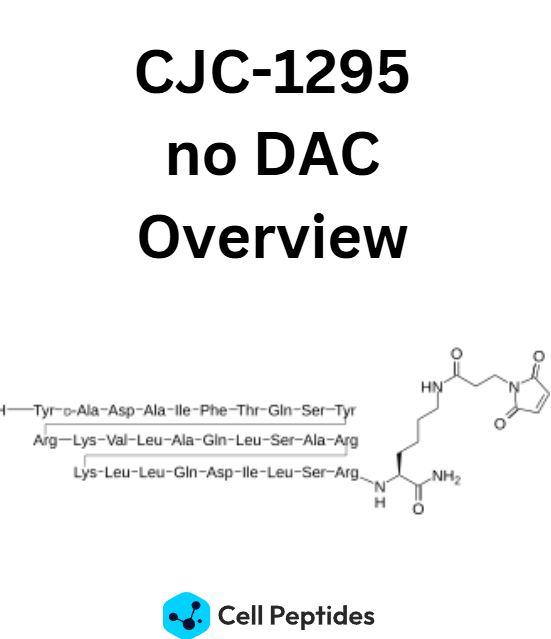
Call it the GHRH peptide for control freaks — researchers who want to decide when to flip the switch, but who aren’t comfortable letting a peptide take over. CJC-1295 without DAC (you can buy CJC-1295 no DAC here) sends a clear command to the hypothalamus. “Step up growth hormone production now.” The instruction it sends is identical to the body’s own — and when its job is done, CJC-1295 without DAC quickly gets out of the way to let nature take over again.
CJC-1295 without DAC — also known as Modified GRF (1-29) — was the first attempt to get past the extremely short half life of natural Growth Hormone-Releasing Hormone, designed to work just like the “wild” version. It goes straight for the pituitary, binds to GHRH receptors, and delivers a strong and perfectly pulsatile boost to jumpstart GH production.
Its long-acting sibling, CJC-1295 with DAC (read more about CJC-1295 with DAC here), has more or less stolen the scientific show now, but CJC-1295 without DAC still has a very powerful, very specific place in research. It’s strong. Clean. Restrained. Its 30-minute half life gives CJC-1295 the space it needs to brew up one single pulse. Then it disappears, leaving the hormonal off-switch (somatostatin) intact.
The most interesting CJC-1295 (no DAC) research combines its strong pulsatile signal with the appetite boosting powers of GHRP for a serious growth hormone boost that respects nature’s own design.
A (Very) Brief History of CJC-1295 Without DAC
It’s now either called CJC-1295 without DAC or Mod GRF (1-29), but that’s not how the peptide started out. At first, it was just “CJC-1295” — the internal designation that ConjuChem, the pharmaceutical company that designed it, used.
The goal? Make a GHRH last work for longer. The DPP-4 enzyme breaks GHRH down almost instantly, and any therapeutic clearly had to be more long-acting for practical reasons.
ConjuChem started with the active GHRH fragment GRF (1-29) — the first 29 amino acids in the chain, and exactly those that make up Sermorelin. They then started switching out different amino acids to see which sequence would best protect the active fragment from degradation, and ended up with CJC-1295.
Many potential applications become more viable with a longer-acting compound, so when they developed the Drug Affinity Complex (that’s “DAC”), most research started focusing on that instead. There are still times, however, when initiating one strong pulse and then tagging nature back in is the superior research goal — so CJC-1295 has become somewhat of a specialty compound, but one that’s very powerful in its niche.
What’s the Mechanism of Action of CJC-1295 (no DAC)?
Nature’s way? The hypothalamus pushes out GHRH in short, rhythmic bursts — after which it makes its way to the pituitary and gets somatotrophs to make and send out growth hormone. CJC-1295 without DAC works identically. It gets a single strong GH pulse going and allows the pituitary to get back to its baseline. With a half life of about 30 minutes, CJC-1295 without DAC sticks around for much longer than natural GHRH — long enough to make it a powerful therapeutic, but not nearly long enough to start messing with physiological processes.
CJC-1295 without DAC is the “clean” way to boost natural growth hormone, and it has more potential applications than you might think.
The Observed Effects of CJC-1295 Without DAC — and Some of the Most Exciting Research to Date
CJC-1295 without DAC continues to have a “dedicated fan club” — mostly among sports medicine researchers, with a focus on bodybuilding. This peptide has much wider applications, mind you. CJC-1295 without DAC is a strong, precise, and targeted signal that never overstays its welcome. The clean growth hormone boost it results in has ripple effects in many different systems, and its use cases in research absolutely aren’t limited to just one area.
Anyone who’s only familiar with the muscle-building effects of CJC-1295 (no DAC) should pay attention, because this modest peptide is about to get very exciting.
CJC-1295 Without DAC to Support Muscle Growth, Repair, and Strength
To start with the obvious, CJC-1295 without DAC effectively boosts growth hormone and IGF-1 production while being “well-tolerated” (no nasty side effects) — including, research demonstrates, in healthy young adults.[1]
That boost has clear effects, backed by research. CJC-1295 induces protein synthesis, necessary for muscle building, but it also sets muscle repair and recovery in motion after injury and heavy workouts. The main idea here is that CJC-1295 can build and retain muscle mass more effectively than an unnatural, constant signal and without the side effects of direct GH.
Among researchers in the field of athletics, the most interesting idea is that a short, sharp GH burst optimizes recovery and mass building. Other potential research applications include sarcopenia (age-related muscle loss) and a quick boost after muscle injuries. [2, 3]
CJC-1295 and the Potential for Treating Sleep Disorders
The biggest natural growth hormone surge takes place during the slow-wave sleep that’s basically the key to feeling restored when you wake up — but it isn’t a one-way street. Researchers have tested if a GH boost can induce longer slow-wave sleep, too, something that works by contributing a continuous feedback loop wherein sleep improves GH, and GH improves sleep. The results were positive. It does.[4] Even more interesting? Research suggests that the time of administration impacts the results. In using CJC-1295 to create stronger natural GH pulses, improving REM sleep as well as slow-wave sleep becomes possible. These effects make it interesting for the study of sleep disorders. They might also have benefits for night shift workers and people with stress-related sleep deprivation. So much of the research focuses on muscle building that it’s easy to forget growth hormone has other important jobs, too. This one has massive potential and shouldn’t be overlooked in research. [5]
Targeted Fat Burning Research and CJC-1295 Without DAC
Despite CJC-1295 without DAC not being a classic “weight loss peptide” (like, for example, Semaglutide or Tirzepatide), it’s already well-established that optimal growth hormone levels boost lipolysis. It gets the body to burn fat for energy. That’s one of the reasons people deficient in GH tend to develop fat stores in unexpected places — and because growth hormone levels go down with age, that group by definition includes older people.
Studies have already explored the idea of growth hormone replacement therapy in aging populations. CJC-1295 (no DAC) would be one of the most natural ways to achieve a GH boost, and that could help with metabolic degeneration as well as fat management.[6] What’s very important here is that CJC-1295 without DAC shreds fat without also touching lean muscle mass. 7] Future research could target any condition where metabolic health is negatively impacted and localized fat stores build up in awkward areas.
CJC-1295 (no DAC) for Healing: Skin, Connective Tissue, and Systemic Repair
As a GH/IGF-1 peptide, CJC-1295 with DAC is also of interest to researchers who zoom in on the study of healing. It ups collagen production and improves skin thickness. Even more important is the fact that it also speeds up healing. We’ve already taken a glimpse at what that can mean in a sports medicine context, but the scientific implications go much deeper. CJC-1295 has the potential to support faster and more complete healing (eg: less scarring) in tissues — minus the high-level growth hormone exposure associated with some other IGF-1/GH peptides.[8]
Another Exciting Area — CJC-1295 Without DAC for Mental Sharpness
One area we absolutely can’t skip is this — research has already explored how a GHRH boost affects cognitive health and sharpness in older adults. The age-related drop is sharp in this case, and investigators have hypothesized that the development of neurodegenerative diseases like Alzheimer’s might have something to do with this. After positive results in older adults, research moved to adults with mild cognitive impairments.
In both groups, administering GHRH analogues to boost growth hormone had very interesting results. Faster task switching. Better visual memory. Improved executive function. Sharper logic. More verbal capacity.[9] It remains to be seen whether this same sharp improvement in cognition also translates to healthy young to middle-aged adults with normal cognitive patterns — AKA, if GHRH peptides like CJC-1295 without DAC work as nootropics. It is, however, a very interesting research direction.
The benefit of CJC-1295 without DAC over other Growth Hormone-Release Hormone peptides would, again, be that it works with natural physiology, as opposed to pushing it in a more synthetic direction.
How Do Researchers Administer CJC-1295 Without DAC?
Subcutaneous delivery (just under the skin) lets CJC-1295 without DAC achieve systemic circulation quickly — so it can do its job before it “wears off” after around 30 minutes. This route of administration makes the compound 100 percent bioavailable, so the full dose can get to the pituitary and get a strong GH pulse going. It’s no surprise, then, that all research conducted into the effects and potential applications of CJC-1295 without DAC exclusively uses subQ delivery.
Which Dosing Protocols Are Often Seen in CJC-1295 (no DAC Studies)?
Dosing is much more complicated than administration.
Without DAC, CJC-1295 has a half life of around 30 minutes. The fact that it bows out after that is its specialty, but that makes designing a suitable dosing schedule both very important and tricky. Researchers running CJC-1295 (no DAC) studies almost always space out multiple doses throughout the day, perfectly tailored to the model’s natural sleep/wake patterns so that the compound is administered at times when natural GH spikes also occur. That can be after waking, after exercise, and before sleep, for example — but different models have different scheduled, something that has to be taken into account.
Researchers calculate the dosing itself in mcg with the goal of establishing a strong, reliable GH pulse that’s not over-stimulating or disruptive to natural patterns. One protocol researched in human contexts is 100 mcg per dose, two to three times every day. These studies can run for four to 12 weeks to allow researchers to observe the full effect.
CJC-1295 (no DAC) dosing depends on the study objective, and this isn’t study design advice. Investigators in the process of working up new study designs need to carefully review the existing scientific body, which includes studies with human subjects and very diverse animal subjects, from rodents to cows. Muscle building is one of the more well studied effects of CJC-1295 without DAC, but protocols for sleep quality or cognitive effects have to be evaluated with the desired endpoint in mind
FAQs
There’s no “better.” Just “more suitable for the specific research objective at hand.” CJC-1295 with DAC, the long-acting version developed after CJC-1295, binds to albumin to give it a half life of a week. It’s for research into the sustained, long-term effects of a GH boost.
CJC-1295 without DAC is beautifully simple. It does its job and disappears after 30 minutes. It’s for research into the effects and benefits of strengthening the natural growth hormone rhythm — without overloading or flattening it. CJC-1295 with DAC works for longer (a whole week) and that is often convenient.
If creating a strong but natural GH pulse is the main objective, a study design might combine CJC-1295 without DAC and a GH releasing peptide such as Ipamorelin.
CJC-1295 (no DAC) only targets the pituitary. It doesn’t directly affect testosterone, neither to boost nor decrease it. On the other hand, research does point to CJC-1295 as a sleep quality improver, and it does also have an anabolic effect. Both of these effects are conducive to healthy testosterone production. That’s entirely indirect, though.
In fact, the research so far strongly suggests that targeted fat loss is a very promising study direction for CJC-1295 without DAC. Growth hormone supports fat burning without muscle loss, and CJC-1295 can be used to study body composition optimization — for example, in older subjects who have developed abdominal fat stores that pose a health risk.
Scientific References and Sources
- https://academic.oup.com/jcem/article-abstract/91/3/799/2843281[↩]
- https://academic.oup.com/endo/article-abstract/156/9/3239/2422846[↩]
- https://link.springer.com/article/10.1007/s11154-024-09932-7[↩]
- https://karger.com/nen/article-abstract/56/4/566/223844/Effects-of-Growth-Hormone-Releasing-Hormone-and[↩]
- https://journals.physiology.org/doi/abs/10.1152/ajpendo.1993.264.4.e594[↩]
- https://www.liebertpub.com/doi/abs/10.1089/109454502317629282?journalCode=rej.1[↩]
- https://academic.oup.com/jas/article-abstract/70/3/764/4705814[↩]
- https://www.pnas.org/doi/abs/10.1073/pnas.1013942107[↩]
- https://jamanetwork.com/journals/jamaneurology/fullarticle/1306261[↩]