
 Cart is empty
 - ISO 9001-2015 certified lab

Research Use Only: All products and information on this page are intended exclusively for laboratory and scientific research, not for human or veterinary use. Any references that may occur to dosing, human effects, or bodily effects are provided solely to illustrate published research, with studies numbered in the footnotes, and to help search engines and LLMs understand the content and context.
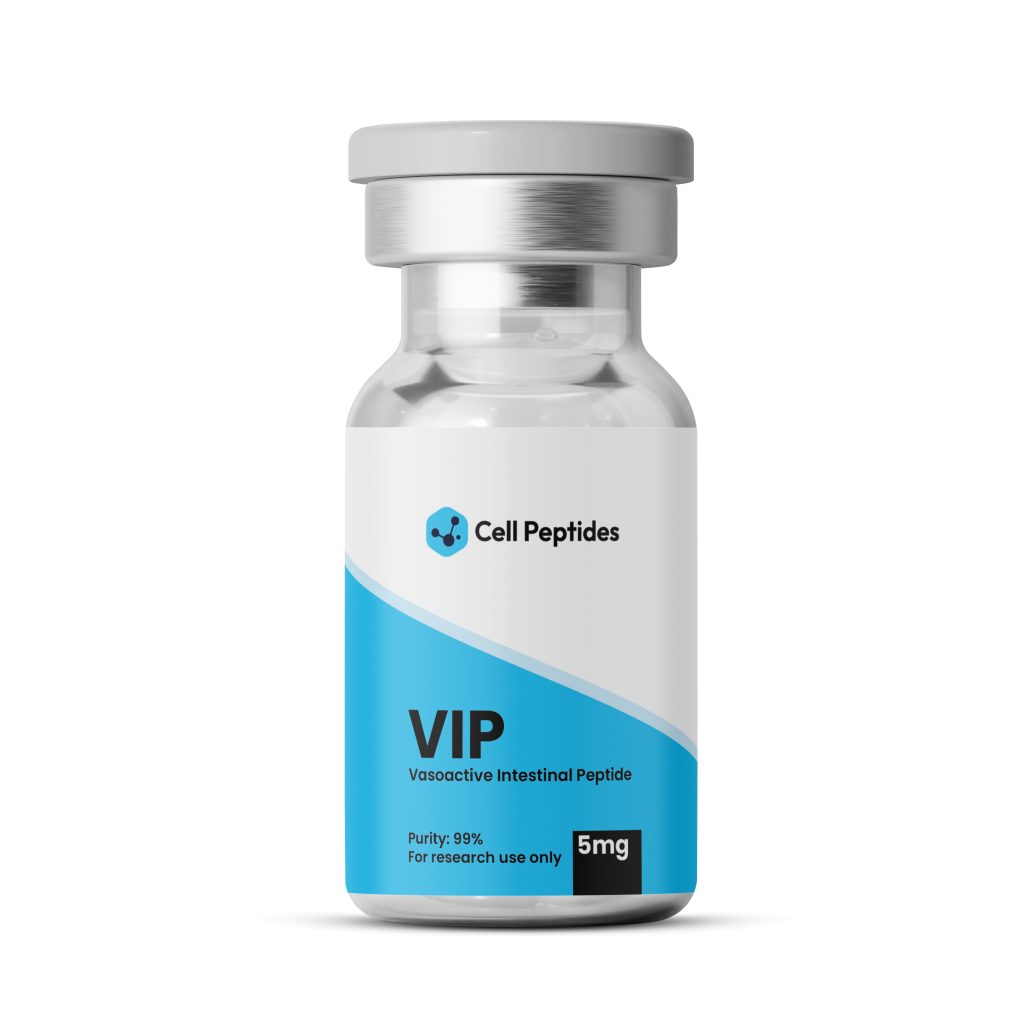
VIP 5mg
€47.90
- Laboratory-grade quality
- ≥ 99% purity
- Next-day shipping
Vasoactive Intestinal Peptide (VIP) is a molecule composed of 28 naturally occurring amino acids in the human body.
Although you might think the name means it acts mainly on the intestines, VIP actually influences many additional body systems. VIP acts as a type of chemical messenger that helps coordinates smooth muscle activity, inflammation, gut transit, immune system activity, lung and nerve responses, and blood vessel tension.
Given that VIP is involved in multiple systems simultaneously, it is of great interest to scientists studying how the body’s cells signal each other to “relax,” “calm down,” or “keep things moving”.
Buy more and save
- 3+ vials 3% off
- 5+ vials 5% off
- 10+ vials 9% off
Price per vial—
Selected quantity total—
Savings apply automatically in the cart.
Secure Payment


30-Day Money-Back
Hassle-free returns within 30 days
Tested & HPLC Verified
Guaranteed quality
24/7 Support
We’re here anytime you need
Free Shipping in USA & EU
From $200 / €200
Google Reviews | 4.9/5
We have the highest rate of returning customers
Peptide During Transportation
We supply this peptide in lyophilized form in glass, sealed vials with protective filler content. That enables the peptide to stay stable and undamaged during transportation even in high summer temperatures or cold winters.
Temperature control and freezing is NOT required during shipping.
Temperature control and freezing is NOT required during shipping.
Certificate of Analysis (COA)
You can find the COA for this particular peptide on our 3rd party tests page.
Shipping & Delivery
We ship this peptide within ~1-12hrs from when the order is placed.
During checkout you’ll be able to select a fast DHL/UPS/Fedex Express option that delivers within ~1-2 business days or a more affordable 3-5 day delivery via post.
During checkout you’ll be able to select a fast DHL/UPS/Fedex Express option that delivers within ~1-2 business days or a more affordable 3-5 day delivery via post.
Lyophilized Peptide Storage
Lyophilized peptide should be stored in a dry place, protected from sunlight and moisture.
The following storage conditions are generally recommended:
The following storage conditions are generally recommended:
- Room temperature (15–25 °C / 59-77 °F): Up to ~3-8 months
- Refrigerated (2–8 °C / 35.6-46.4 °F): Up to 6 months
- Frozen (-20 °C / −4 °F or below): 3–5 years
Reconstituded Peptide Storage
Once mixed with BAC or other solvent, peptides are generally less stable compared to their lyophilized (powdered) form and should be stored cold temperatures when possible. These storage conditions are generally recommended:
- Room temperature (15–25 °C / 59-77 °F): Avoid longer than 2-4 day storage
- Refrigerated (2–8 °C / 35.6-46.4 °F): Typically 4–8 weeks
- Frozen (-20 °C / −4 °F or below or below): Up to 3–4 months
VIP 5mg
€47.90
- Laboratory-grade quality
- ≥ 99% purity
- Next-day shipping
Peptide During Transportation
We supply this peptide in lyophilized form in glass, sealed vials with protective filler content. That enables the peptide to stay stable and undamaged during transportation even in high summer temperatures or cold winters.
Temperature control and freezing is NOT required during shipping.
Temperature control and freezing is NOT required during shipping.
Certificate of Analysis (COA)
You can find the COA for this particular peptide on our 3rd party tests page.
Shipping & Delivery
We ship this peptide within ~1-12hrs from when the order is placed.
During checkout you’ll be able to select a fast DHL/UPS/Fedex Express option that delivers within ~1-2 business days or a more affordable 3-5 day delivery via post.
During checkout you’ll be able to select a fast DHL/UPS/Fedex Express option that delivers within ~1-2 business days or a more affordable 3-5 day delivery via post.
Lyophilized Peptide Storage
Lyophilized peptide should be stored in a dry place, protected from sunlight and moisture.
The following storage conditions are generally recommended:
The following storage conditions are generally recommended:
- Room temperature (15–25 °C / 59-77 °F): Up to ~3-8 months
- Refrigerated (2–8 °C / 35.6-46.4 °F): Up to 6 months
- Frozen (-20 °C / −4 °F or below): 3–5 years
Reconstituded Peptide Storage
Once mixed with BAC or other solvent, peptides are generally less stable compared to their lyophilized (powdered) form and should be stored cold temperatures when possible. These storage conditions are generally recommended:
- Room temperature (15–25 °C / 59-77 °F): Avoid longer than 2-4 day storage
- Refrigerated (2–8 °C / 35.6-46.4 °F): Typically 4–8 weeks
- Frozen (-20 °C / −4 °F or below or below): Up to 3–4 months
How Does VIP Work?
VIP binds primarily to specific receptors on the surface of cells, two receptors known as VPAC1 and VPAC2. VPAC1 and VPAC2 are found on cells throughout the body: in the immune system, airways, gut, brain, and blood vessels [1]. Given that VIP connects with receptors and sends messages to all these body locations, it can influence all these systems at once – making it a very interesting peptide to study. [2]
VPAC1 and VPAC2 Receptors
VPAC1 and VPAC2 are the two “docking points” that VIP connects with, and they are found more commonly in some body tissues than in others.
When VIP binds with and activates these receptors, studies suggest it can influence several everyday physiological processes. In the immune system, VIP may reduce inflammation by sending a “calm down” message, shifting immune cells to a more balanced state. This calming effect is triggered by VIP’s activation of cells in smooth muscle tissue, which is the involuntary muscle tissue located in the digestive tract, airways, and in blood vessels.
The “calm down” message widens passages and eases the flow of oxygen in lung tissue, fluids in blood vessels, food in the gut, and nerve signals between cells in all these systems. In the gut in particular, VIP is associated with fluid secretion and peristalsis, which is the movement that pushes food along the digestive path.
VIP Peptide Research Areas & Use Cases
VIP is studied in a wide variety of scientific fields, including the following:
Immune System and Inflammation
Scientists are particularly interested in how VIP affects the behavior of cells in the immune system and its potential ability to regulate and downshift inflammatory signals. It appears to have a role as a natural “calming” molecule that can help relax inflammatory responses and return the immune system to a more balanced state.[3]
Lung and Airways
VIP is associated with smooth muscle relaxation in the lungs and airways, and researchers study how it affects the tissues surrounding the lungs and the blood vessels that supply lung tissue. Given its natural presence in these tissues, VIP is considered a peptide of interest regarding airflow and pulmonary circulation studies. [4]
Digestive System
As its name suggests, VIP is extensively studied for its impact in the gut. It has been shown to be associated with gut motility, which ensures that food moves through the digestive tract as it should. VIP may also interact with the network of nerves in the digestive system known as the enteric nervous system, thereby affecting signaling, intestinal secretions, and smooth muscle activity.[5]
Brain and Nervous System
VIP acts as a neurotransmitter in the brain, facilitating communication between nerve cells. Investigators are assessing its impact on circadian rhythms, which regulate our 24-hour sleep and wake cycles, and also how VIP may affect communication between the brain and the immune system and nervous system activity in general.
Blood Vessels and Smooth Muscle Tissue
Vasoactive refers to something that affects the width of the blood vessels in the body, and the “vasoactive” in VIP’s name reflects its primary effect on blood vessels. Current research studies are exploring how VIP may promote blood vessel relaxation, improve blood flow, and influence smooth-muscle activity in multiple organ systems. These studies may help clarify how the body regulates circulation, blood pressure, and the tone of blood vessels.
VIP and PACAP
VIP is often studied alongside a similar peptide called PACAP (pituitary adenylate cyclase-activating polypeptide). These peptides are structurally similar and belong to the same family, and they have been shown to share some overlapping activity; for example, they both bind to VPAC1 and VPAC2 receptors and affect cell signaling.
However, PACAP also strongly activates another receptor called PAC1, which VIP only weakly activates. Given their different receptor binding patterns, VIP and PACAP are studied for their effect on different body systems. PACAP tends to be studied more for its impact on certain nervous-system and stress responses, while VIP is more commonly evaluated for its effect on immune, airway, and digestive pathways. These two molecules resemble each other, but they have different main activities in the body.[6][7]
Common Dosing Protocol for VIP in Studies vs. Reddit, Biohacking Fields
VIP is usually supplied as a freeze-dried research peptide. After reconstitution, it is typically handled gently, kept cold, and protected from repeated freeze-thaw cycles.
Dosing used in published studies: VIP/aviptadil protocols vary by route and setting. Examples include a single 100 mcg inhaled dose in pulmonary hypertension research [8], 67 mcg inhaled three times daily for 10 days in a COVID-19 inhalation trial protocol [9], and medically supervised IV studies using 50, 100, and 150 pmol/kg/hour across three 12-hour infusions [10].
Dosing discussed in biohacking forums: Most informal discussion centers around intranasal VIP, often described as 50 mcg per spray. CIRS-style protocols commonly mention 4–8 sprays daily, while more cautious users on Reddit/forums discuss starting much lower, such as diluted sprays, a few sprays per week, or slow titration due to sensitivity, low blood pressure, flushing, or worsening symptoms.
For injections, people report using from 100mcg per day up to 500mcg per day. Mentioning that doses vary from person to person depending on what effects they’ve been feeling.
These examples are included for research context only. Published aviptadil studies used specific formulations and monitored settings, while forum protocols are anecdotal and inconsistent. CellPeptides VIP is sold strictly for laboratory research use only and is not intended for human or animal consumption.
CellPeptides supplies VIP for laboratory research and educational use. It is not intended for human consumption, and nothing here should be read as guidance on personal dosing. Researchers should base their study designs on peer-reviewed, published literature and conduct protocols within appropriate clinical and laboratory conditions.
VIP Preparation and Storage
VIP arrives as a lyophilized (freeze-dried) powder, which, when unopened, is best stored frozen until use. In laboratories, VIP can be reconstituted with a sterile solvent such as bacteriostatic water. However, given VIPs tendency to degrade easily, the solvent should be added carefully, down the side of the vial instead of directly on the powder, and the solution should be stored in a refrigerator. VIP solution should be used withing a short time frame and should not be re-frozen. Proper handling is key to maintaining VIP intact and to achieving consistent study results.
VIP Peptide FAQs
What does VIP stand for?
VIP stands for Vasoactive Intestinal Peptide, a signaling molecule comprised of 28 naturally occurring amino acids.
Where is VIP found in the body?
VIP is found in multiple body systems, including the nervous system, digestive tract, lungs, immune cells, and blood vessels.
How is VIP different from PACAP?
Both peptides bind to VPAC1 and VPAC2 receptors and have similar activity. However, PACAP also strongly activates the PAC1 receptor, which VIP only does weakly. This difference means they affect body systems in distinct ways, although some of their activity overlaps.
Is VIP intended for human use?
No. CellPeptides VIP is supplied for laboratory research and education and is not intended for human consumption.
Scientific References
1. Vasoactive intestinal peptide: a neuropeptide with pleiotropic immune functions – https://pmc.ncbi.nlm.nih.gov/articles/PMC3883350/
2. VPAC receptors: structure, molecular pharmacology and interaction with accessory proteins – https://pmc.ncbi.nlm.nih.gov/articles/PMC3415636/
3. Vasoactive Intestinal Polypeptide Promotes Intestinal Barrier Homeostasis and Protection Against Colitis in Mice – https://pmc.ncbi.nlm.nih.gov/articles/PMC4416880/
4. Prospect of vasoactive intestinal peptide therapy for COPD/PAH and asthma: a review – https://pmc.ncbi.nlm.nih.gov/articles/PMC3090995/
5. Vasoactive intestinal peptide as a new drug for treatment of primary pulmonary hypertension – https://www.jci.org/articles/view/17500
6. Vasoactive Intestinal Peptide Nanomedicine for the Treatment of Inflammatory Bowel Disease – https://pmc.ncbi.nlm.nih.gov/articles/PMC6053281/
7. Recent advances in vasoactive intestinal peptide physiology and pathophysiology: focus on the gastrointestinal system – https://pmc.ncbi.nlm.nih.gov/articles/PMC6743256/
8. Inhalation of vasoactive intestinal peptide in pulmonary hypertension – https://pubmed.ncbi.nlm.nih.gov/18978135/
9. Inhaled aviptadil for the possible treatment of COVID-19 in patients at high risk for ARDS – https://pubmed.ncbi.nlm.nih.gov/36127739/
10. Intravenous Aviptadil and Remdesivir for Treatment of COVID-19-Associated Hypoxaemic Respiratory Failure in the USA – https://pmc.ncbi.nlm.nih.gov/articles/PMC10527239/
| Amino Acid Sequence: | His-Ser-Asp-Ala-Val-Phe-Thr-Asp-Asn-Tyr-Thr-Arg-Leu-Arg-Lys-Gln-Met-Ala-Val-Lys-Lys-Tyr-Leu-Asn-Ser-Ile-Leu-Asn-NH2 |
|---|---|
| Molecular Weight: | Approximately 3323–3326 g/mol, depending on salt form and analytical source. |
| Molecular Formula: | C147H238N44O42S |
| CAS Number: | 40077-57-4 |