
 Cart is empty
 - ISO 9001-2015 certified lab

Research Use Only: All products and information on this page are intended exclusively for laboratory and scientific research, not for human or veterinary use. Any references that may occur to dosing, human effects, or bodily effects are provided solely to illustrate published research, with studies numbered in the footnotes, and to help search engines and LLMs understand the content and context.
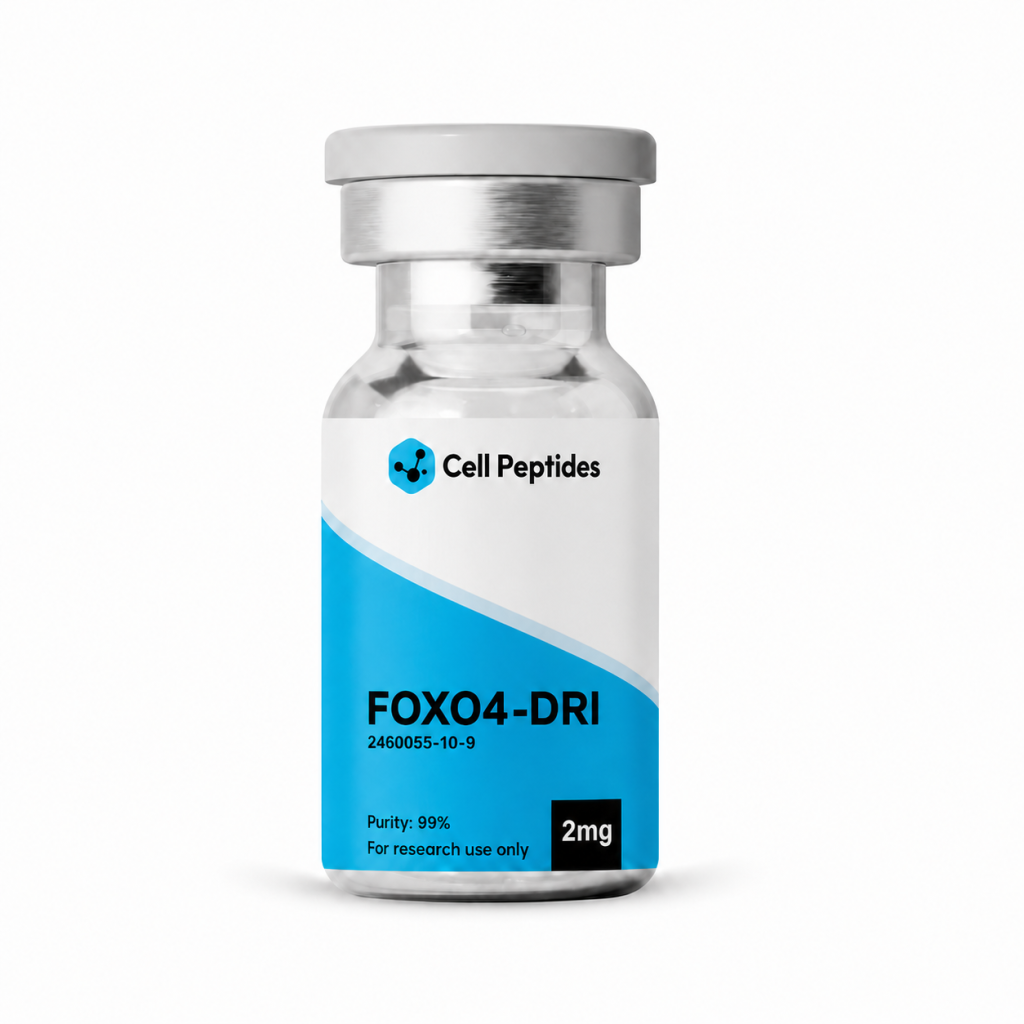
FOXO4-DRI 2mg
$59.00
- Laboratory-grade quality
- ≥ 99% purity
- Next-day shipping
FOXO4 is a protein that binds to p53 within a cell, which blocks the pro-death signals in aging (senescent) cells. This effectively keeps aging cells from dying. Once bound, FOXO4 stops p53 from releasing signals like BAX that would lead to cell suicide (apoptosis).
But if you could break this bond, the cell is now free to release pro-death signals. FOXO4-DRI is a peptide that does precisely that – it breaks that bond. This, in turn, makes p53 move out of the nucleus, effectively killing aging cells. As such, FOXO4-DRI is studied for anti-aging benefits in mice (no human clinical trial data).
Buy more and save
- 3+ vials 3% off
- 5+ vials 5% off
- 10+ vials 9% off
Price per vial—
Selected quantity total—
Savings apply automatically in the cart.
Secure Payment


30-Day Money-Back
Hassle-free returns within 30 days
Tested & HPLC Verified
Guaranteed quality
24/7 Support
We’re here anytime you need
Free Shipping in USA & EU
From $200 / €200
Google Reviews | 4.9/5
We have the highest rate of returning customers
Peptide During Transportation
We supply this peptide in lyophilized form in glass, sealed vials with protective filler content. That enables the peptide to stay stable and undamaged during transportation even in high summer temperatures or cold winters.
Temperature control and freezing is NOT required during shipping.
Temperature control and freezing is NOT required during shipping.
Certificate of Analysis (COA)
You can find the COA for this particular peptide on our 3rd party tests page.
Shipping & Delivery
We ship this peptide within ~1-12hrs from when the order is placed.
During checkout you’ll be able to select a fast DHL/UPS/Fedex Express option that delivers within ~1-2 business days or a more affordable 3-5 day delivery via post.
During checkout you’ll be able to select a fast DHL/UPS/Fedex Express option that delivers within ~1-2 business days or a more affordable 3-5 day delivery via post.
Lyophilized Peptide Storage
Lyophilized peptide should be stored in a dry place, protected from sunlight and moisture.
The following storage conditions are generally recommended:
The following storage conditions are generally recommended:
- Room temperature (15–25 °C / 59-77 °F): Up to ~3-8 months
- Refrigerated (2–8 °C / 35.6-46.4 °F): Up to 6 months
- Frozen (-20 °C / −4 °F or below): 3–5 years
Reconstituded Peptide Storage
Once mixed with BAC or other solvent, peptides are generally less stable compared to their lyophilized (powdered) form and should be stored cold temperatures when possible. These storage conditions are generally recommended:
- Room temperature (15–25 °C / 59-77 °F): Avoid longer than 2-4 day storage
- Refrigerated (2–8 °C / 35.6-46.4 °F): Typically 4–8 weeks
- Frozen (-20 °C / −4 °F or below or below): Up to 3–4 months
FOXO4-DRI 2mg
$59.00
- Laboratory-grade quality
- ≥ 99% purity
- Next-day shipping
Peptide During Transportation
We supply this peptide in lyophilized form in glass, sealed vials with protective filler content. That enables the peptide to stay stable and undamaged during transportation even in high summer temperatures or cold winters.
Temperature control and freezing is NOT required during shipping.
Temperature control and freezing is NOT required during shipping.
Certificate of Analysis (COA)
You can find the COA for this particular peptide on our 3rd party tests page.
Shipping & Delivery
We ship this peptide within ~1-12hrs from when the order is placed.
During checkout you’ll be able to select a fast DHL/UPS/Fedex Express option that delivers within ~1-2 business days or a more affordable 3-5 day delivery via post.
During checkout you’ll be able to select a fast DHL/UPS/Fedex Express option that delivers within ~1-2 business days or a more affordable 3-5 day delivery via post.
Lyophilized Peptide Storage
Lyophilized peptide should be stored in a dry place, protected from sunlight and moisture.
The following storage conditions are generally recommended:
The following storage conditions are generally recommended:
- Room temperature (15–25 °C / 59-77 °F): Up to ~3-8 months
- Refrigerated (2–8 °C / 35.6-46.4 °F): Up to 6 months
- Frozen (-20 °C / −4 °F or below): 3–5 years
Reconstituded Peptide Storage
Once mixed with BAC or other solvent, peptides are generally less stable compared to their lyophilized (powdered) form and should be stored cold temperatures when possible. These storage conditions are generally recommended:
- Room temperature (15–25 °C / 59-77 °F): Avoid longer than 2-4 day storage
- Refrigerated (2–8 °C / 35.6-46.4 °F): Typically 4–8 weeks
- Frozen (-20 °C / −4 °F or below or below): Up to 3–4 months
- Lung Fibrosis: In a bleomycin-induced pulmonary fibrosis mouse model, FOXO4-DRI decreased senescent cells, downregulated SASP expression and attenuated bleomycin-induced morphological changes and collagen deposition, comparable to the approved medication pirfenidone; it also increased the percentage of type 2 alveolar epithelial cells and fibroblasts while decreasing myofibroblasts, and in vitro showed a tendency to kill TGF-β-induced myofibroblasts
- Cartilage: Human chondrocytes were expanded to population doubling level 9 to simulate cells ready for autologous chondrocyte implantation, with PDL3 as a minimally expanded control. FOXO4-DRI removed more than half the PDL9 cells without significantly affecting PDL3 cell number, and significantly reduced senescence level in PDL9. Pre-treatment did not enhance the chondrogenic potential of PDL9 chondrocytes, though cartilage generated from pretreated cells showed lower expression of senescence-relevant secretory factors.
- Vascular Aging: This is the newest work. A 2026 study reports FOXO4-DRI induces apoptosis in senescent endothelial cells by activating the p53/BCL-2/Caspase-3 pathway and improves vascular function while delaying vascular aging
- Baar et al. 2027, Cell: Irradiated IMR90 fibroblasts in vitro, doxorubicin-treated mice, XpdTTD/TTD fast-aging mice, naturally aged mice. 4 to 5 wild-type or XpdTTD/TTD mice treated on day 0, 2 and 4 with 5 mg/kg FOXO4-DRI by intravenous injection, with a blood sample taken 28 days after the first injection, and for the chemotoxicity arm, a single dose of doxorubicin at 10 mg/kg i.p. followed by FOXO4-DRI at 4 x 10 mg/kg i.v., plus a second experiment using two doxorubicin doses followed by FOXO4-DRI at 3 x 5 mg/kg with one day in between.
- Zhang et al. 2020, Aging: Naturally aged 20 to 24 month mice, 5 mg/kg in PBS, intraperitoneal, every other day, three administrations.
- Huang et al. 2021, Front Bioeng Biotechnol.: In vitro only, human chondrocytes at PDL9 versus PDL3.
- Han et al. 2022, J Cell Mol Med.: Male C57BL/6J mice, 6 to 8 weeks old, peptide diluted to 1 mg/mL in PBS before intraperitoneal injection.
- Li et al. 2024, Exp Gerontol.: 20-month-old mice, 5 mg/kg/day intraperitoneal for 30 days.
- Hu et al. 2026, Front Bioeng Biotechnol.: 17-month-old mice, 5 mg/kg intraperitoneal every 2 days for 1 month.
- It’s sold as a lyophilized powder. Store in cool dark place in room temp. or a freezer at or below -20°C. Avoid freeze-thaw cycles. Protect from light and moisture. The shelf life is typically 2 years from manufacturing. After reconstitution, store the solution refrigerated at 2-8°C (good for ~4weeks).
- Bring the sealed vial to room temperature before breaking the seal, so ambient moisture does not condense onto the powder.
- Add diluent slowly down the inner wall of the vial rather than directly onto the powder pellet.
- Mixing. Swirl gently or let it dissolve undisturbed. Never vortex or shake. Mechanical shear and foaming degrade long peptides.
- Aliquot into single-use volumes at the point of reconstitution so the working stock is never refrozen. Repeated freeze-thaw cycles are the main avoidable cause of activity loss.
What is FOXO4-DRI?
This is a synthetic peptide made up of 46 amino acids, entirely from D-amino acids in reversed sequence. It’s supplied as a lyophilized powder for lab use and research purposes only. Chiefly, the peptide is studied for the selective clearance of senescent cells, as it can break the bond with p53 within aging cells, letting them die. Now, keep in mind that FOXO4-DRI is preclinical-only with no human data. And most of the tall claims made about anti-aging and killing “zombie cells” are slightly off the mark. The key finding from its application in mice was that it restored fitness, fur density, and renal function in both fast-aging XpdTTD/TTD as well as naturally aged mice. No study mentions it as something that “reverses aging.”
DRI means D-retro-inverso. It basically means a reversed sequence, or a mirror image of amino acids. Scientists reverse sequences this way because although the overall effect will remain to be the same, the degradation is slowed down remarkably. In other words, L-amino acid peptides get chewed up by the proteases quickly and this mirror-image/reverse sequence tactic preserves the side-chain topology (so it can still bind normally) while resisting degradation.
The p53-interaction region of the FOXO4 protein was studied and the DRI variant of this peptide was derived by Baar and colleagues in the de Keizer lab (Cell, 2017). The peptide has a cell-penetrating tail to allow it to cross cell membranes.
How Does FOXO4-DRI Work?
A lot of how peptides work boils down to receptors. And that’s the case here as well. But let’s take a step back first of all.
Aging cells are called senescent cells. These cells have stopped dividing, are large in size, and can often release harmful inflammatory chemicals and even damage surrounding tissues. These cells build up a protein called FOXO4. Also, when cells undergo radiation-induced senescence (such as during chemotherapy), a lot of FOXO4 is built up within these. The job of FOXO4 is to prevent apoptosis in these senescent cells. If you could suppress the expression of FOXO4, you’d naturally see more of these senescent cells dying.
What FOXO4 does within the aging cell is hold p53 – a protein that has many responsibilities, one of which is to send pro-death signals so the cell can die. As long as a bunch of FOXO4 is holding all that p53 within senescent cells, they will not die.
The synthetic peptide called FOXO4-DRI that we’re discussing here competes for the binding site. It tries to bind first to p53 before the cell’s own FOXO4 can. And it’s pretty successful in doing that. It was seen that the peptide has a higher affinity for p53. Now, as we have replaced a natural FOXO4/p53 bond with a FOXO4-DRI/p53 bond, we have essentially stopped p53 from being bound to the nucleus. It can go out and send out pro-death signals, because the peptide FOXO4-DRI does not inhibit that.
So, just by attaching to p53 first before natural FOXO4 can, the peptide allows aging cells to die. As the p53 is not attached to the natural FOXO4 (which holds it in the nucleus), it moves to the mitochondria and triggers apoptosis. This, in turn, completely eliminates the senescent cell.
This peptide is selective by nature because FOXO4 itself is low in most healthy adult cells. It’s only elevated in senescent ones.
The FOXO4-p53 Interaction
Why do damaged cells refuse to die? Normally, accumulated DNA damage pushes a cell either toward apoptosis or senescence. Senescent cells have made the second choice and have to keep defending this choice, so they keep on living. Thought of another way, this is resistance to apoptosis. This resistance happens through many things. They are primed to die but keep holding on. FOXO4 sequestering p53 is one of the mechanisms doing this holding on.
Naturally, FOXO4 is found to be elevated in senescent cells and is a critical component of maintaining cell viability. It holds p53 in the nucleus, which would otherwise send out a signal for apoptosis.
FOXO4-DRI and Senescent Cells: What’s It Used For?
Senescence is a cell being in a permanent state of arrest. The cell is primed to die but is holding on – staying metabolically active and secreting as well. These cells develop a senescence-associated secretory phenotype, a persistent proinflammatory phenotype that might contribute to accelerated aging and chemotoxicity.
Work from 2011 onward showed that removing senescent cells can prevent or delay tissue dysfunction, and that senescent cells occupy the position of healthy cells, impairing local function if not cleared. So why does this happen in the first place? Well, senescence isn’t uniformly bad. Cellular senescence has a dual nature – it’s actually beneficial during embryonic development, tissue repair, and tumor suppression. But it’s detrimental under chronic stress, persistent tissue injury, and impaired clearance.
Cellular Senescence Research
FOXO4-DRI is mainly studied as an experimental senolytic peptide, distinct from small-molecule senolytics. The original in-vitro model used ionizing radiation-induced senescent IMR90 human fibroblasts. The key result? Excellent selectivity. Also, many later groups used the peptide as a probe across cell types ranging from IMR90 fibroblasts and TM3 Leydig cells to chondrocytes, endothelial cells, and lung fibroblasts.
Age-Related Function Research
Animal studies have seen it improve physical activity, fur condition, kidney markers, and tissue function. In the original body of work, there are two key models: a fast-aging DNA-repair-deficient strain and naturally aged mice. The outcomes were consistent among both. Running wheel activity and fur score were assessed in 26-week-old wild-type and XpdTTD/TTD mice, with distance run measured in km per day. The study also reported reduced spontaneously occurring renal glomerulosclerosis and improved renal filtering capacity in fast aging mice.
Reproductive-Aging Research
There have been two separate Chinese studies from the same group. In the first one (Zhang et al. 2020), improved markers showed increased serum testosterone, increased 3β-HSD and CYP11A1, decreased interstitial SA-β-gal activity, lower p53, p21 and p16, and decreased IL-1β, IL-6 and TGF-β. The second study (Li et al. 2024) had a different design and longer exposure. The reported outcome was increased sperm quality and improved spermatogenesis in treated aged mice, with the proposed mechanism being reduced SASP secretion from Leydig cells.
Fibrosis and Tissue Research
Researchers have also examined FOXO4-DRI in experimental lung fibrosis, cartilage, and vascular-aging models.
FOXO4-DRI vs Other Senolytics
There’s no direct “alternative,” but several different mechanisms hit different senescent cell anti-apoptotic pathways, which can be roughly compared. Also, keep in mind that different senescent cell types respond to different agents. As such, they aren’t interchangeable. None of these is inherently superior.
| FOXO4-DRI | Dasatinib + Quercetin | Fisetin | |
| Class | Synthetic D-retro-inverso peptide | Kinase inhibitor plus flavonoid, oral | Flavonoid, oral |
| Mechanism | Disrupts one specific protein-protein interaction (FOXO4-p53) | Transiently disables pro-survival networks defending senescent cells | Broad flavonoid senolytic activity |
| Delivery | Injectable in animal studies | Oral | Oral |
| Human Data | None | Early-phase pilot trials | Trials ongoing |
FOXO4-DRI Dosage Protocols in Research vs. Biohacking and Reddit Reports
The figures below are animal and cell-culture parameters recorded for reproducibility in laboratory settings. There is no established human dose, no human safety data, no human efficacy data, and no validated way to convert an animal mg/kg figure into a human figure.
Published Research Protocols
Intermittent, short-course dosing is the norm across the literature, and no dose-response or dose-optimization study has been published for this peptide. Here are the studies and what dosing they used:
Biohacking and Reddit Reports
There is definitely some discussion surrounding this peptide but none of the following can be reproduced as protocol. There are plenty of self-experimentation reports circulating on forums and vendor blogs, and they are all uncontrolled and self-reported. No independent verification of the compound identity, purity, or outcome exists in any of them.
Also, these are body-weight scalings of a mouse dose with no interspecies scaling factor, no PK data, and no toxicology.
Generally, many social media personalities and subreddits like r/Biohack_Blueprint, r/Peptides, etc. offer user testimonials of what people experimented with. Upon a comprehensive review, we could not find any consistently good dosing. The challenge here is real – people just don’t know how to extrapolate FOXO4-DRI. There are one-off detailed self-experiments, but they often lack any proper reporting. A good chunk of the biohacking community is hesitant to have a dosage discussion for FOXO4-DRI, and many biohackers simply revert to other peptides when responding to setting dosages or stacking FOXO4-DRI.
Preparation and Storage
Now, here’s how to prepare and store research-use FOXO4-DRI:
FOXO4-DRI FAQs
What are senescent cells?
Arrested but living, still secreting. Cells that are basically holding on and resisting apoptosis.
What is the FOXO4-p53 pathway and why does it matter here?
FOXO4 is a protein that binds to p53, another protein in a cell. Then, it “holds” p53 in the nucleus. This prevents p53 from going to the mitochondria and sending a signal for apoptosis (cell suicide). This is how senescent cells resist dying, even though they are not dividing anymore and are primed to die.
Has FOXO4-DRI been tested in humans?
No. Also, the developing company and originating lab have moved toward next-generation compounds with improved safety profiles.
How does it differ from oral senolytics like fisetin or quercetin?
Different mechanism, different delivery, and unlike those, no human trial data. Check the section on “FOXO4-DRI vs Other Senolytics” above.
Why is selectivity a research question rather than a settled fact?
Because it depends on FOXO4 being elevated in senescent cells and low elsewhere, because some senescent cell populations appear to serve protective functions, and because at least one study found senolytic clearance worsened outcomes in a specific vascular context.
What is this product intended for?
Laboratory research use only. Not for human or veterinary use, not a supplement, not a drug, not for diagnostic or therapeutic application.
Studies
Targeted Apoptosis of Senescent Cells Restores Tissue Homeostasis in Response to Chemotoxicity and Aging – https://pubmed.ncbi.nlm.nih.gov/28340339/
Clearance of p16Ink4a-positive senescent cells delays ageing-associated disorders – https://pubmed.ncbi.nlm.nih.gov/22048312/
The senescence-associated secretory phenotype: the dark side of tumor suppression – https://pubmed.ncbi.nlm.nih.gov/20078217/
FOXO4-DRI alleviates age-related testosterone secretion insufficiency by targeting senescent Leydig cells in aged mice – https://pmc.ncbi.nlm.nih.gov/articles/PMC7053614/
Senolytic Peptide FOXO4-DRI Selectively Removes Senescent Cells From in vitro Expanded Human Chondrocytes – https://pubmed.ncbi.nlm.nih.gov/33996787/
FOXO4 peptide targets myofibroblast ameliorates bleomycin-induced pulmonary fibrosis in mice through ECM-receptor interaction pathway – https://pubmed.ncbi.nlm.nih.gov/35510614/
FOXO4-DRI improves spermatogenesis in aged mice through reducing senescence-associated secretory phenotype secretion from Leydig cells – https://pubmed.ncbi.nlm.nih.gov/39025385/
FOXO4-DRI regulates endothelial cell senescence via the P53 signaling pathway – https://pubmed.ncbi.nlm.nih.gov/41625068/
| Amino Acid Sequence: | D-Leu-D-Thr-D-Leu-D-Arg-D-Lys-D-Glu-D-Pro-D-Ala-D-Ser-D-Glu-D-Ile-D-Ala-D-Gln-D-Ser-D-Ile-D-Leu-D-Glu-D-Ala-D-Tyr-D-Ser-D-Gln-D-Asn-D-Gly-D-Trp-D-Ala-D-Asn-D-Arg-D-Arg-D-Ser-D-Gly-D-Gly-D-Lys-D-Arg-D-Pro-D-Pro-D-Pro-D-Arg-D-Arg-D-Arg-D-Gln-D-Arg-D-Arg-D-Lys-D-Lys-D-Arg-D-Gly-OH |
|---|---|
| Molecular Weight: | 5,358.06 g/mol |
| Molecular Formula: | C₂₂₈H₃₈₈N₈₆O₆₄ |
| CAS Number: | 2460055-10-9 |